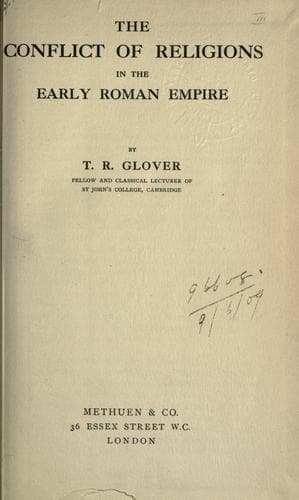
The Conflict of Religions in the Early Roman EmpireGlover, T. R. (Terrot Reaveley)
Religion
The Conflict of Religions in the Early Roman Empire
Glover, T. R. (Terrot Reaveley)
Christianity and other religions; Church history -- Primitive and early church, ca. 30-600; Rome -- Religion
With "the sentence of death in themselves" the early Christians faced
the world, and astonished it by more than their "stubbornness." They
were the most essentially happy people of the day--Jesus was their
hope, their sufficiency was of God, their names were written in heaven,
they were full of love for all men--they had "become little children,"
as Jesus put it, glad and natural. Jesus had brought them into a new
world of possibilities. A conduct that ancient moralists dared not
ask, the character of Jesus suggested, and the love of Jesus made
actual. "I can do all things," said Paul, "in him that strengtheneth
me." They looked to assured victory over evil and they achieved it.
"This is the victory that _has_ overcome the world--our faith." Very
soon a new note is heard in their words. Stoicism was never
"essentially musical"; Epictetus announces a hymn to Zeus,[82] but he
never starts the tune. Over and over again there is a sound of singing
in Paul--as in the eighth chapter of the _Romans_, and the thirteenth
of _First Corinthians_,[83] and it repeats itself. "Children of joy"
is Barnabas' name for his friends.[84] {166} "Doing the will of Christ
we shall find rest," wrote the unknown author of "Second Clement."[85]
"Praising we plough; and singing we sail," wrote the greater
Clement.[86] "Candidates for angelhood, even here we learn the strain
hereafter to be raised to God, the function of our future glory," said
Tertullian.[87] "Clothe thyself in gladness, that always has grace with
God and is welcome to him--and revel in it. For every glad man does
what is good, and thinks what is good.... The holy spirit is a glad
spirit ... yes, they shall all live to God, who put away sadness from
themselves and clothe themselves in all gladness." So said the angel
to Hermas,[88] and he was right. The holy spirit was a glad spirit,
and gladness--joy in the holy spirit--was the secret of Christian
morality. Nothing could well be more gay and happy than Clement's
_Protrepticus_. Augustine was attracted to the church because he saw
it _non dissolute hilaris_. Such happiness in men is never without a
personal centre, and the church made no secret that this centre was
"Jesus Christ, whom you have not seen, but you love him; whom yet you
see not, but you believe in him and rejoice with joy unspeakable and
glorified."[89]
Chapter V Footnotes:
[1] See Burkitt's _Early Eastern Christianity_.
[2] See Justin, _Apology_, i, 14, a vivid passage on the change of
character that has been wrought in men by the Gospel. Cf. Tert. _ad
Scap._ 2, _nec aliunde noscibiles quam de emendatione vitiorum
pristinorum_.
[3] Ephesians iv, 4.
[4] 1 Peter ii, 7.
[5] Tertullian, _ad Nationes_, i, 8, _Plane, tertium genus dicimur ...
verum recogitate ne quos tertium genus dicitis principem locum
obtineant, siquidem non ulla gens non Christiana_.
[6] Cf. Jeremiah xxxi, 31--a favourite passage with Christian
apologists.
Public-domain text, read in full here on John Shaqi.
Reviews
Reviews
No reviews yet
Be the first to share your thoughts on this work.
Elsewhere in the archive
Join the Discussion
Join the discussion
Sign in to leave a comment or review.
Sign InorCreate an account