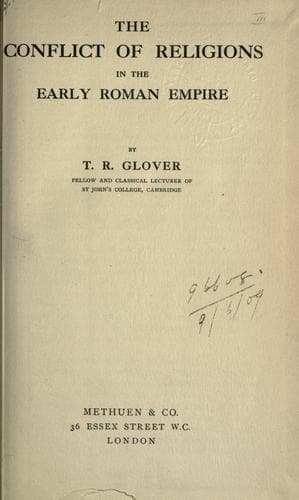
The Conflict of Religions in the Early Roman EmpireGlover, T. R. (Terrot Reaveley)
Religion
The Conflict of Religions in the Early Roman Empire
Glover, T. R. (Terrot Reaveley)
Christianity and other religions; Church history -- Primitive and early church, ca. 30-600; Rome -- Religion
One very obscure person of this period remains to be noticed, who in
his small sphere gave his views to mankind in a way of his own.
In 1884 two French scholars, MM. Holleaux and Paris were exploring the
ruins of Oinoanda, a Greek city in Lycia, and they came upon a number
of inscribed stones, most of them built in a wall. What was unusual
was that these were neither fragments of municipal decrees nor of
private monuments, but all formed part of one great inscription which
dealt apparently with some philosophic subject. In June 1895 two
Austrian {218} scholars, MM. Heberdey and Kalinka, re-collated the
inscription and found some further fragments, and now the story is
tolerably clear, and a curious one it is.[50]
It appears that the fragments originally belonged to an inscription
carved on the side of a colonnade, and they fall into three series
according to their place on the wall--one above another. The middle
series consists of columns of fourteen lines, the letters 1-1/2 to 2
centimetres high, fifteen or sixteen in a line,--each column forming a
page, as it were; and it extends over some twenty-one or two yards.
The lowest series is in the same style. On top is a series of columns
added later (as the inscription shows) and cut in letters of 2-1/2-3
centimetres, generally ten lines to the column--the larger size to
compensate for the greater height above the ground, for it was all
meant to be read. The inscription begins:--
"Diogenes to kinsmen, household and friends, this is my charge. Being
so ill that it is critical whether I yet live or live no longer--for an
affection of the heart is carrying me off--if I survive, I will gladly
accept the life yet given to me; if I do not survive, _DO_..."
[Sidenote: Diogenes of Oinoanda]
There ends a column, and a line or two has been lost at the top of what
seems to be the next, after which come the words "a kindly feeling for
strangers also who may be staying here," and the incomplete statement
which begins "knowing assuredly, that by knowledge of the matters
relating to Nature and feelings, which I have set forth in the spaces
below...." It is evident that Diogenes had something to say which he
considered it a duty to make known. This proves to have been the
Epicurean theory of life; and here he had carved up for all to read a
simple exposition of the philosophy of his choice.
Public-domain text, read in full here on John Shaqi.
Reviews
Reviews
No reviews yet
Be the first to share your thoughts on this work.
Elsewhere in the archive
Join the Discussion
Join the discussion
Sign in to leave a comment or review.
Sign InorCreate an account