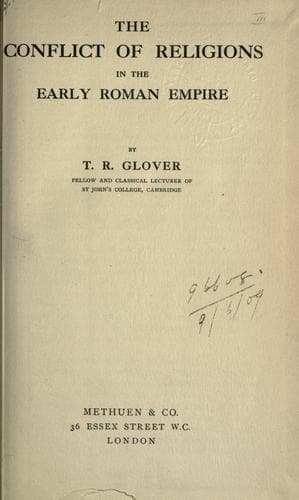
The Conflict of Religions in the Early Roman EmpireGlover, T. R. (Terrot Reaveley)
Religion
The Conflict of Religions in the Early Roman Empire
Glover, T. R. (Terrot Reaveley)
Christianity and other religions; Church history -- Primitive and early church, ca. 30-600; Rome -- Religion
Then those mysterious "somethings" which Apuleius keeps {230} wrapped
up in a napkin? "I have been initiated in many of the mysteries of
Greece. Certain symbols and memorials of these, given to me by the
priests, I sedulously preserve. I say nothing unusual, nothing
unknown. To take one instance, those among you who are _mystae_ of
Father Liber [Bacchus] know what it is you keep laid away at home, and
worship in secret, far from all profane eyes. Now, I, as I said, from
enthusiasm for truth and duty toward the gods, I have learnt many
sacred mysteries, very many holy rites, and divers ceremonies"--the
audience will remember he said as much three years ago in his now very
famous speech about AEsculapius--"then could it seem strange to anyone,
who has any thought of religion, that a man, admitted to so many divine
mysteries, should keep certain emblems of those holy things at home,
and wrap them in linen, the purest covering for things divine?" Some
men--the prosecutor among them--count it mirth to mock things divine;
no, he goes to no temple, has never prayed, will not even put his hand
to his lips when he passes a shrine,--why! he has not so much as an
anointed stone or a garlanded bough on his farm.[80]
One last flourish may deserve quotation. If you can prove, says
Apuleius, any material advantage accruing to me from my marriage, "then
write me down the great Carmendas or Damigeron or _his_ ... Moses or
Jannes or Apollobeches or Dardanus himself, or anyone else from
Zoroaster and Ostanes downwards who has been famous among
magicians."[81] Several of these names occur in other authors,[82] but
the corruption is more interesting. Has some comparative fallen out,
or does _his_ conceal another name? Is it _ihs_, in fact,--a reference
to Jesus analogous to the suggestion of Celsus that he too was a
magician?
The philosophical works of Apuleius need not detain us, but a little
space may be spared to his book _On the God of Socrates_, where he sets
forth in a clear and vivid way that doctrine of daemonic beings, which
lies at the heart of ancient {231} religion, pre-eminently in this
period, from Plutarch onwards. His presentment is substantially the
same as Plutarch's, but crisper altogether, and set forth in the
brilliant rhetoric, to which the Greek did not aspire, and from which
the African could not escape, nor indeed wished to escape.
Public-domain text, read in full here on John Shaqi.
Reviews
Reviews
No reviews yet
Be the first to share your thoughts on this work.
Elsewhere in the archive
Join the Discussion
Join the discussion
Sign in to leave a comment or review.
Sign InorCreate an account