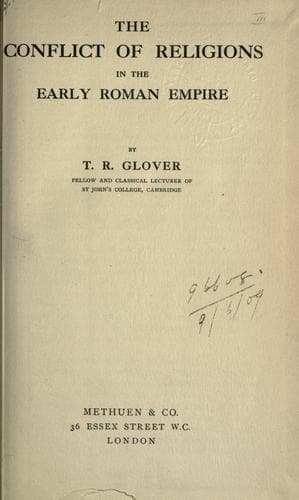
The Conflict of Religions in the Early Roman EmpireGlover, T. R. (Terrot Reaveley)
Religion
The Conflict of Religions in the Early Roman Empire
Glover, T. R. (Terrot Reaveley)
Christianity and other religions; Church history -- Primitive and early church, ca. 30-600; Rome -- Religion
Of the personal history of Celsus nothing can be said, but the features
of his mind are well-marked. He was above all a man of
culture,--candid, scholarly and cool. He knew and admired the
philosophical writings of ancient Greece, he had some knowledge of
Egypt, and he also took the pains to read the books of the Jews and the
Christians. On the whole he leant to Plato, but, like many philosophic
spirits, he found destructive criticism more easy than the elaboration
of a system of his own. Yet here we must use caution, for the object
he had set before him was not to be served by individual speculation.
It was immaterial what private opinions he might hold, for his great
purpose was the abandonment of particularism and the fusion of all
parties for the general good. Private judgment run mad was the mark of
all Christians, orthodox and heretical,--"men walling themselves off
and isolating themselves from mankind"[4]--and his thesis was that the
whole spirit of the movement was wrong. A good citizen's part was
loyal acceptance of the common belief, deviation from which was now
shown to impair the solidarity of the civilized world. Of course such
a position is never taken by really independent thinkers; but it is the
normal standpoint of men to whom practical {241} affairs are of more
moment than speculative precision--men, who are at bottom sceptical,
and have little interest in problems which they have given up as
insoluble. Celsus was satisfied with the established order, alike in
the regions of thought and of government. He mistrusted new
movements--not least when they were so conspicuously alien to the Greek
mind as the new superstition that came from Palestine. He has all the
ancient contempt of the Greek for the barbarian, and, while he is
influenced by the high motive of care for the State, there are traces
of irritation in his tone which speak of personal feeling. The folly
of the movement provoked him.
[Sidenote: The Christian propaganda]
Public-domain text, read in full here on John Shaqi.
The Conflict of Religions in the Early Roman Empire — John Shaqi
Reviews
Reviews
No reviews yet
Be the first to share your thoughts on this work.
Elsewhere in the archive
Join the Discussion
Join the discussion
Sign in to leave a comment or review.
Sign InorCreate an account