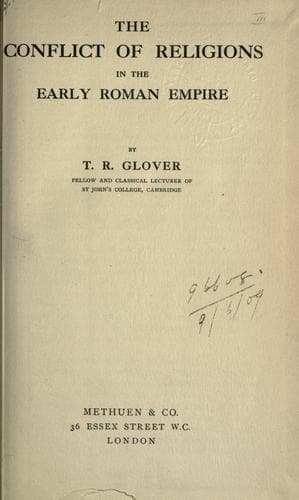
The Conflict of Religions in the Early Roman EmpireGlover, T. R. (Terrot Reaveley)
Religion
The Conflict of Religions in the Early Roman Empire
Glover, T. R. (Terrot Reaveley)
Christianity and other religions; Church history -- Primitive and early church, ca. 30-600; Rome -- Religion
still in the thick of them; perhaps he might not reach wisdom, but he
would at least live for mankind "as one born for others,"[39] would do
nothing for glory, and all for conscience, would be gentle and
accessible even to his foes; as for wealth, it gave a wise man more
opportunity, but if his riches deserted him, they would take nothing
else with them; a philosopher might have wealth, "if it be taken
forcibly from no man, stained with no man's blood, won by no wrong done
to any, gained without dishonour; if its spending be as honest as its
getting, if it wake no envy but in the envious."[40] The treatise has
a suggestion of excitement, and there is a good deal of rhetoric in it.
Now he proposed to the Emperor to put his words into action, and Nero
would not permit him--he was not ready for the odium of despoiling his
guardian, and the old man's name might still be of use to cover deeds
in which he had no share. Seneca was not to resign his {47} wealth nor
to leave Rome. Nero's words as given by Tacitus are pleasant enough,
but we hardly need to be told their value.[41]
[Sidenote: Seneca's last days]
It was merely a reservation of the death sentence, and Seneca must have
known it. The only thing now was to wait till he should receive the
order to die, and Seneca occupied the time in writing. If what he
wrote has a flushed and excited air, it is not surprising. The
uncertainty of his position had preyed upon him while he was still
Minister--"there are many," he had written, "who must hold fast to
their dizzy height; it is only by falling that they can leave it."[42]
He had fallen, and still he had to live in uncertainty; he had always
been a nervous man.
The end came in 65, in connexion with the conspiracy of Piso. Tacitus
is not altogether distinct as to the implication of Seneca in this
plot, but modern historians have inclined to believe in his guilt--if
guilt it was.[43] Mr Henderson, in particular, is very severe on him
for this want of "gratitude" to his benefactor and pupil, but it is
difficult to see what Nero had done for him that he would not have
preferred undone.[44] Perhaps at the time, and certainly later on,
Seneca was regarded as a possible substitute for Nero upon the
throne;[45] but he was well over sixty and frail, nor is it clear that
the world had yet decided that a man could be Emperor without being a
member of the Julian or Claudian house. Seneca, in fact any man, must
have felt that any one would be better than Nero, but he had himself
conspicuously left the world, and, with his wife, was living the
philosophic life--a vegetarian again, and still a water-drinker.[46]
Seneca was ready for the death-summons and at once opened his veins.
Death came slowly, but it came; and he died, eloquent to the
last--_novissimo quoque momenta suppeditante eloquentia_.
Public-domain text, read in full here on John Shaqi.
Reviews
Reviews
No reviews yet
Be the first to share your thoughts on this work.
Join the Discussion
Join the discussion
Sign in to leave a comment or review.
Sign InorCreate an account