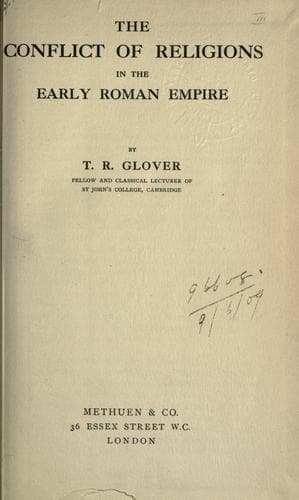
The Conflict of Religions in the Early Roman EmpireGlover, T. R. (Terrot Reaveley)
Religion
The Conflict of Religions in the Early Roman Empire
Glover, T. R. (Terrot Reaveley)
Christianity and other religions; Church history -- Primitive and early church, ca. 30-600; Rome -- Religion
Such is the story of Seneca. Even in bare outline it shows something
of his character--his kindliness and sensibility, his weakness and
vanity; but there are other features revealed in his books and his many
long letters to Lucilius. No Roman, perhaps, ever laid more stress on
the duty of gentleness and forgiveness.[47] "Look at the City of
Rome," he says, "and the {48} crowds unceasingly pouring through its
broad streets--what a solitude, what a wilderness it would be, were
none left but whom a strict judge would acquit. We have all done wrong
(_peccavimus_), some in greater measure, some in less, some on purpose,
some by accident, some by the fault of others; we have not stood
bravely enough by our good resolutions; despite our will and our
resistance, we have lost our innocence. Nor is it only that we have
acted amiss; we shall do so to the end."[48] He is anxious to make
Stoicism available for his friends; he tones down its gratuitous
harshness, accommodates, conciliates. He knows what conscience is; he
is recognized as a master in dealing with the mind at variance with
itself, so skilfully does he analyse and lay bare its mischiefs.
Perhaps he analyses too much--the angel, who bade Hermas cease to ask
concerning sins and ask of righteousness, might well have given him a
word. But he is always tender with the man to whom he is writing. If
he was, as Quintilian suggests, a "splendid assailant of the faults of
men," it is the faults of the unnamed that he assails; his friends'
faults suggest his own, and he pleads and sympathizes. His style
corresponds with the spirit in which he thinks. "You complain," he
writes to Lucilius, "that my letters are not very finished in style.
Who talks in a finished style unless he wishes to be affected? What my
talk would be, if we were sitting or walking together, unlaboured and
easy, that is what I wish my letters to be, without anything precious
or artificial in them."[49] And he has in measure succeeded in giving
the air of talk to his writing--its ease, its gaiety, even its rambling
and discursiveness. He always sees the friend to whom he writes, and
talks to him--sometimes at him--and not without some suggestion of
gesticulation. He must have talked well--though one imagines that,
like Coleridge on Highgate Hill, he probably preferred the listener who
sat "like a passive bucket to be pumped into." Happily the reader is
not obliged to be quite so passive.
Public-domain text, read in full here on John Shaqi.
Reviews
Reviews
No reviews yet
Be the first to share your thoughts on this work.
Join the Discussion
Join the discussion
Sign in to leave a comment or review.
Sign InorCreate an account