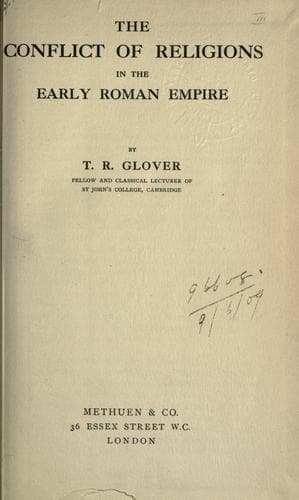
The Conflict of Religions in the Early Roman EmpireGlover, T. R. (Terrot Reaveley)
Religion
The Conflict of Religions in the Early Roman Empire
Glover, T. R. (Terrot Reaveley)
Christianity and other religions; Church history -- Primitive and early church, ca. 30-600; Rome -- Religion
The story of Epictetus can be more briefly told, for there is very
little to tell.[52] He was born at Hierapolis in Phrygia:--he was the
slave of Nero's freedman Epaphroditus, and somehow managed to hear the
lectures of the Stoic Musonius. Eventually he was set free, and when
Domitian expelled the philosophers from Rome, he went to Nicopolis in
Epirus,[53] where he lived and taught--lame, neat, poor and old. How
{50} he taught is to be seen in the discourses which Arrian took down
in the reign of Trajan,--"Whatever I heard him say, I tried to write
down exactly, and in his very words as far as I could--to keep them as
memorials for myself of his mind and of his outspokenness. So they
are, as you would expect, very much what a man would say to another on
the spur of the moment--not what he would write for others to read
afterwards.... His sole aim in speaking was to move the minds of his
hearers to the best things. If then these discourses should achieve
this, they would have the effect which I think a philosopher's words
should have. But if they do not, let my readers know that, when he
spoke them, the hearer could not avoid being affected as Epictetus
wished him to be. If the discourses do not achieve this, perhaps it
will be my fault, or perhaps it may be inevitable. Farewell."
[Sidenote: Epictetus on children and women]
Such, save for a sentence or two omitted, is Arrian's
preface,--thereafter no voice is heard but that of Epictetus. To
place, time or persons present the barest allusions only are made.
"Someone said ... And Epictetus spoke." The four books of Arrian give
a strong impression of fidelity. We hear the tones of the old man, and
can recognize "the mind and the outspokenness," which Arrian cherished
in memory--we understand why, as we read. The high moral sense of the
teacher, his bursts of eloquence, his shrewdness, his abrupt turns of
speech, his apostrophes--"Slave!" he cries, as he addresses the
weakling--his diminutives of derision, produce the most lively sense of
a personality. There is wit, too, but like Stoic wit in general it is
hard and not very sympathetic; it has nothing of the charm and delicacy
of Plato's humour, nor of its kindliness.
Public-domain text, read in full here on John Shaqi.
Reviews
Reviews
No reviews yet
Be the first to share your thoughts on this work.
Elsewhere in the archive
Join the Discussion
Join the discussion
Sign in to leave a comment or review.
Sign InorCreate an account