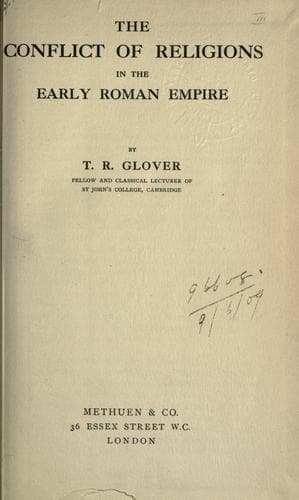
The Conflict of Religions in the Early Roman EmpireGlover, T. R. (Terrot Reaveley)
Religion
The Conflict of Religions in the Early Roman Empire
Glover, T. R. (Terrot Reaveley)
Christianity and other religions; Church history -- Primitive and early church, ca. 30-600; Rome -- Religion
But we shall not do him justice if we do not recognize his high
character. In an age when it was usual to charge every one with
foulness, natural and unnatural, Dio Cassius alone among writers
suggests it of Seneca; and, quite apart from his particular bias in
this case, Dio is not a high authority,--more {49} especially as he
belonged to a much later generation. If his talk is of "virtue!
virtue!" Seneca's life was deliberately directed to virtue. In the
midst of Roman society, and set in the highest place but one in the
world, he still cherished ideals, and practised self-discipline, daily
self-examination. "This is the one goal of my days and of my nights:
this is my task, my thought--to put an end to my old faults."[50] His
whole philosophy is practical, and directed to the reformation of
morals. The Stoic paradoxes, and with them every part of philosophy
which has no immediate bearing upon conduct, he threw aside. His
language on the accumulation of books recalls the amusement of St
Francis at the idea of possessing a breviary. And further, we may note
that whatever be charged against him as a statesman, not his own
master, and as a writer, not always quite in control of his rhetoric,
Seneca was fundamentally truthful with himself. He never hid his own
weakness; he never concealed from himself the difficulty of his ideals;
he never tried to delude himself with what he could not believe. The
Stoics had begun long since to make terms with popular religion, but
Seneca is entirely free from delusions as to the gods of popular
belief. He saw clearly enough that there was no truth in them, and he
never sought help from anything but the real. He is a man, trained in
the world,[51] in touch with its problems of government, with the
individual and his questions of character, death and eternity,--a man
tender, pure and true--too great a man to take the purely negative
stand of Thrasea, or to practise the virtue of the schools in "arrogant
indolence." But he has hardly reached the inner peace which he sought.
Public-domain text, read in full here on John Shaqi.
Reviews
Reviews
No reviews yet
Be the first to share your thoughts on this work.
Join the Discussion
Join the discussion
Sign in to leave a comment or review.
Sign InorCreate an account