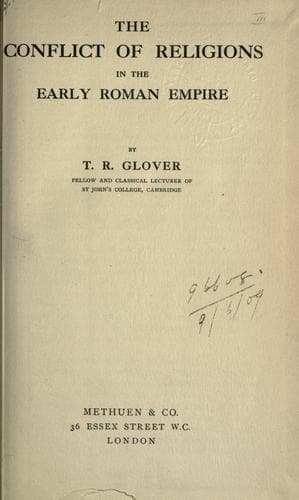
The Conflict of Religions in the Early Roman EmpireGlover, T. R. (Terrot Reaveley)
Religion
The Conflict of Religions in the Early Roman Empire
Glover, T. R. (Terrot Reaveley)
Christianity and other religions; Church history -- Primitive and early church, ca. 30-600; Rome -- Religion
As to women, a few quotations will show his detachment. He seems
hardly to have known a good woman. "Do not admire your wife's beauty,
and you are not angry with the adulterer. Learn that a thief and an
adulterer have no place among the things that are yours, but among
those which are not yours and not in your power,"[60] and he
illustrates his philosophy with an anecdote of an iron lamp stolen from
him, which he replaced with an earthenware one. From fourteen years
old, he says, women think of nothing and aim at nothing {52} but lying
with men.[61] Roman women liked Plato's Republic for the licence they
wrongly supposed it gave.[62] He constantly speaks of women as a
temptation, nearly always using a diminutive _korasion_,
_korasidion_--little girls--and as a temptation hardly to be resisted
by young men. He speaks of their "softer voices."[63] A young
philosopher is no match for a "pretty girl"; let him fly
temptation.[64] "As to pleasure with women, abstain as far as you can,
before marriage; but if you do indulge in it, do it in the way
conformable to custom. Do not, however, be disagreeable to those who
take such pleasures, nor apt to rebuke them or to say often that you do
not."[65] All this may be taken as the impression left by Rome and the
household of Epaphroditus upon a slave's mind. It may be observed that
he makes nothing like Dio Chrysostom's condemnation of prostitution--an
utterance unexampled in pagan antiquity.
It is pleasanter to turn to other features of Epictetus. He has a very
striking lecture on personal cleanliness.[66] In proportion as men
draw near the gods by reason, they cling to purity of soul and body.
Nature has given men hands and nostrils; so, if a man does not use a
handkerchief, "I say, he is not fulfilling the function of a man."
Nature has provided water. "It is impossible that some impurity should
not remain in the teeth after eating. 'So wash your teeth,' says
Nature. Why? 'That you may be a man and not a beast--a pig.'" If a
man would not bathe and use the strigil and have his clothes
washed--"either go into a desert where you deserve to go, or live alone
and smell yourself." He cannot bear a dirty man,--"who does not get
out of his way?" It gives philosophy a bad name, he says; but it is
quite clear that that was not his chief reason. He would sooner a
young man came to him with his hair carefully trimmed than with it
dirty and rough; such care implied "some conception of the beautiful,"
which it was only necessary to direct towards the things of the mind;
"but if a man comes to me filthy and dirty, with a moustache down to
his knees--what _can_ I say to him?" "But whence am I to get a fine
cloak? Man! you have water; wash it!"
{53}
[Sidenote: Fame of Epictetus]
Public-domain text, read in full here on John Shaqi.
Reviews
Reviews
No reviews yet
Be the first to share your thoughts on this work.
Elsewhere in the archive
Join the Discussion
Join the discussion
Sign in to leave a comment or review.
Sign InorCreate an account