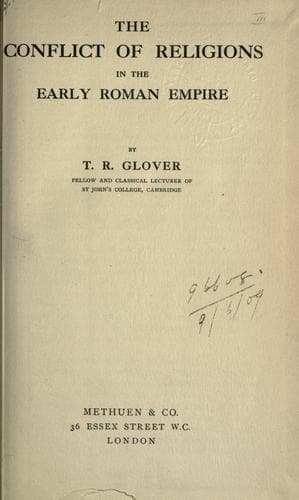
The Conflict of Religions in the Early Roman EmpireGlover, T. R. (Terrot Reaveley)
Religion
The Conflict of Religions in the Early Roman Empire
Glover, T. R. (Terrot Reaveley)
Christianity and other religions; Church history -- Primitive and early church, ca. 30-600; Rome -- Religion
Men sought the help of the philosopher, and relapsed. "He thinks he
wishes reason. He has fallen out with luxury, but he will soon make
friends with her. But he says he is offended with his own life! I do
not deny it; who is not? Men love their vices and hate them at the
same time."[75] So writes Seneca of a friend of Lucilius and his
fugitive thoughts of amendment, and Epictetus is no less emphatic on
the crying need for earnestness. The Roman world was so full of
glaring vice that every serious man from Augustus onward had insisted
on some kind of reformation, and now men were beginning to feel that
the reformation must begin within themselves. The habit of daily
self-examination became general among the Stoics, and they recommended
it warmly to their pupils. Here is Seneca's account of himself.
"When the day was over and Sextius had gone to his night's rest, he
used to ask his mind (_animum_): 'what bad habit of yours have you
cured to-day? what vice have you resisted? in what respect are you
better?' Anger will cease and will be more moderate, when it knows it
must daily face the judge. Could anything be more beautiful than this
habit of examining the whole day? What a sleep is that which follows
self-scrutiny! How calm, how deep and free, when the mind is either
praised or admonished, when it has looked into itself, and like a
secret censor makes a report upon its own moral state. I avail myself
of this power and daily try my own case. When the light is removed
from my sight, and my wife, who knows my habit, is silent, I survey my
whole day and I measure my words again. I hide nothing from myself; I
pass over nothing. For why should I be afraid of any of my errors,
when I can say: 'See that you do it no more, now I forgive you. In
that discussion, you spoke too pugnaciously; after this do not engage
with the ignorant; they will not learn who have never {55} learned.
That man you admonished too freely, so you did him no good; you
offended him. For the future, see not only whether what you say is
true, but whether he to whom it is said will bear the truth.'"[76]
Similar passages might be multiplied. "Live with yourself and see how
ill-furnished you are," wrote Persius (iv, 52) the pupil of Cornutus.
"From heaven comes that word 'know thyself,'" said Juvenal. A rather
remarkable illustration is the letter of Serenus, a friend of Seneca's,
of whose life things are recorded by Tacitus that do not suggest
self-scrutiny. In summary it is as follows:--
Public-domain text, read in full here on John Shaqi.
Reviews
Reviews
No reviews yet
Be the first to share your thoughts on this work.
Elsewhere in the archive
Join the Discussion
Join the discussion
Sign in to leave a comment or review.
Sign InorCreate an account