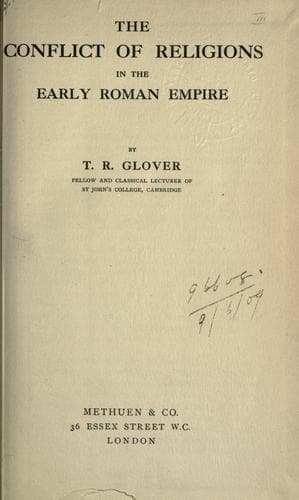
The Conflict of Religions in the Early Roman EmpireGlover, T. R. (Terrot Reaveley)
Religion
The Conflict of Religions in the Early Roman Empire
Glover, T. R. (Terrot Reaveley)
Christianity and other religions; Church history -- Primitive and early church, ca. 30-600; Rome -- Religion
This reference to Syrians and Egyptians is probably not idle. The
prevalence of Syrian and Egyptian religions, inculcating ecstatic
communion with a god and the soul's need of preparation for the next
world, contributed to the change that is witnessed in Stoic philosophy.
The Eastern mind is affecting the Greek, and later Stoicism like later
Platonism has thoughts and ideals not familiar to the Greeks of earlier
days. It was with religions, as opposed to city cults, that Stoicism
had now to compete for the souls of men; and while it retains its Greek
characteristics in its intellectualism and its slightly-veiled contempt
for the fool and the barbarian, it has taken on other features. It was
avowedly a rule of life rather than a system of speculation; and it was
more, for the doctrine of the Spermaticos Logos (the Generative Reason)
gave a new meaning to conduct and opened up a new and rational way to
God. Thus Stoicism, while still a philosophy was pre-eminently a
religion, and even a gospel--Good News of emancipation from the evil in
the world and of union with the Divine.
[Sidenote: The true worship of the gods]
Stoicism gave its convert a new conception of the relation of God and
man. One Divine Word was the essence of both--Reason was shared by men
and gods, and by pure thought men came into contact with the divine
mind. Others sought communion in trance and ritual--the Stoic when he
was awake, at his highest and best level, with his mind and not his
hand, in thoughts, which he could understand and assimilate, rather
than in magical formulae, which lost their value when they became {57}
intelligible. God and men formed a polity, and the Stoic was the
fellow-citizen of the gods, obeying, understanding and adoring, as they
did, one divine law, one order--a partaker of the divine nature, a
citizen of the universe, a free man as no one else was free, because he
knew his freedom and knew who shared it with him. He stood on a new
footing with the gods, and for him the old cults passed away,
superseded by a new worship which was divine service indeed.
Public-domain text, read in full here on John Shaqi.
Reviews
Reviews
No reviews yet
Be the first to share your thoughts on this work.
Elsewhere in the archive
Join the Discussion
Join the discussion
Sign in to leave a comment or review.
Sign InorCreate an account