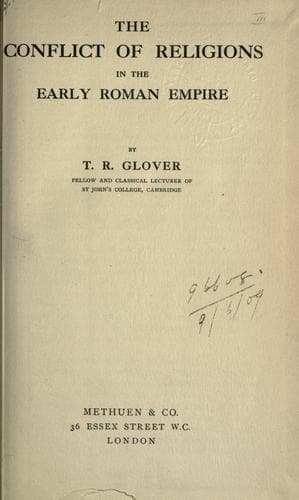
The Conflict of Religions in the Early Roman EmpireGlover, T. R. (Terrot Reaveley)
Religion
The Conflict of Religions in the Early Roman Empire
Glover, T. R. (Terrot Reaveley)
Christianity and other religions; Church history -- Primitive and early church, ca. 30-600; Rome -- Religion
"How the gods are to be worshipped, men often tell us. Let us not
permit a man to light lamps on the Sabbath, for the gods need not the
light, and even men find no pleasure in the smoke. Let us forbid to
pay the morning salutation and to sit at the doors of the temples; it
is human interest that is courted by such attentions: God, he worships
who knows Him. Let us forbid to take napkins and strigils to Jove, to
hold the mirror to Juno. God seeks none to minister to him; nay!
himself he ministers to mankind; everywhere he is, at the side of every
man. Let a man hear what mode to keep in sacrifices, how far to avoid
wearisomeness and superstition: never will enough be done, unless in
his mind he shall have conceived God as he ought, as in possession of
all things, as giving all things freely. What cause is there that the
gods should do good? Nature. He errs, who thinks they _can_ not do
harm; they _will_ not. They cannot receive an injury nor do one. To
hurt and to be hurt are one thing. Nature, supreme and above all most
beautiful, has exempted them from danger and from being dangerous. The
beginning of worship of the gods is to believe gods are; then to
attribute to them their own majesty, to attribute to them goodness,
without which majesty is not, to know it is they who preside over the
universe, who rule all things by their might, who are guardians of
mankind; at times[82] thoughtful of individuals. They neither give nor
have evil; but they chastise, they check, they assign penalties and
sometimes punish in the form of blessing. Would you propitiate the
gods? Be good! He has worshipped them enough who has imitated
them."[83]
{58}
This is not merely a statement of Stoic dogma; it was a proclamation of
freedom. Line after line of this fine passage directly counters what
was asserted and believed throughout the world by the adherents of the
Eastern religions. Hear Seneca once more.
[Sidenote: Providence]
"We understand Jove to be ruler and guardian of the whole, mind and
breath of the Universe (_animum spiritumque mundi_), lord and artificer
of this fabric. Every name is his. Would you call him fate? You will
not err. He it is on whom all things depend, the cause of causes.
Would you call him Providence? You will speak aright. He it is whose
thought provides for the universe that it may move on its course unhurt
and do its part. Would you call him Nature? you will not speak amiss.
He it is of whom all things are born, by whose breath (_spiritu_) we
live. Would you call him Universe? You will not be deceived. He
himself is this whole that you see, fills his own parts, sustains
himself and what is his."[84]
Public-domain text, read in full here on John Shaqi.
Reviews
Reviews
No reviews yet
Be the first to share your thoughts on this work.
Elsewhere in the archive
Join the Discussion
Join the discussion
Sign in to leave a comment or review.
Sign InorCreate an account