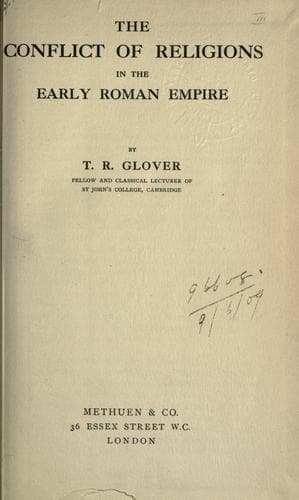
The Conflict of Religions in the Early Roman EmpireGlover, T. R. (Terrot Reaveley)
Religion
The Conflict of Religions in the Early Roman Empire
Glover, T. R. (Terrot Reaveley)
Christianity and other religions; Church history -- Primitive and early church, ca. 30-600; Rome -- Religion
Everything with the Stoic turns on the individual. _ta epi soi_, "the
things in your own power," is the refrain of Epictetus' teaching. All
is thrown upon the individual will, upon "the universal" working in the
individual, according to Stoic theory, "upon me" the plain man would
say. If the gods, as Seneca says, lend a hand to such as climb, the
climber has to make his own way by temperance and fortitude. The "holy
spirit within us" is after all hardly to be distinguished from
conscience, intellect and will.[123] God, says Epictetus, ordains "if
you wish good, get it from yourself."[124] Once the will
(_proairesis_) is right, {66} all is achieved.[125] "You must exercise
the will (_thelesai_)--and the thing is done, it is set right; as on
the other hand, only fall a nodding and the thing is lost. For from
within (_esothen_) comes ruin, and from within comes help."[126] "What
do you want with prayers?" asks Seneca, "make yourself happy."[127]
The old Stoic paradox about the "folly" of mankind, and the
worthlessness of the efforts of all save the sage, was by now chiefly
remembered by their enemies.[128]
All this is due to the Stoic glorification of reason, as the embodiment
in man of the Spermaticos Logos. Though Nous with the Stoics is not
the pure dry light of reason, they tended in practice to distinguish
reason from the emotions or passions (_pathe_), in which they saw
chiefly "perturbations," and they held up the ideal of freedom from
them in consequence (_apatheia_).[129] To be godlike, a man had to
suppress his affections just as he suppressed his own sensations of
pain or hunger. Every human instinct of paternal or conjugal love, of
friendship, of sympathy, of pity, was thus brought to the test of a
Reason, which had two catch-words by which to try them--the "Universe"
and "the things in your own power"--and the sentence was swift and
summary enough. They did not realize that for most men--and probably
it is truest of the best men--Life moves onward with all its tender and
gracious instincts, while Analysis limps behind. The experiment of
testing affection and instinct by reason has often been tried, and it
succeeds only where the reason is willing to be a constitutional
monarch, so to say, instead of the despot responsible only to the vague
concept of the Universe, whom the Stoics wished to enthrone. They
talked of living according to Nature, but they were a great deal too
quick in deciding what was Nature. If the centuries have taught us
anything, it is to give Nature more time, more study and more respect
than even yet we do. There are words {67} at the beginning of the
thirteenth book of the "Prelude" wiser and truer than anything the
Stoics had to say of her with their "excessive zeal" and their "quick
turns of intellect." Carried away by their theories (none, we must
remember as we criticize them, without some ground in experience and
observation), the Stoics made solitude in the heart and called it
peace.
Public-domain text, read in full here on John Shaqi.
Reviews
Reviews
No reviews yet
Be the first to share your thoughts on this work.
Elsewhere in the archive
Join the Discussion
Join the discussion
Sign in to leave a comment or review.
Sign InorCreate an account