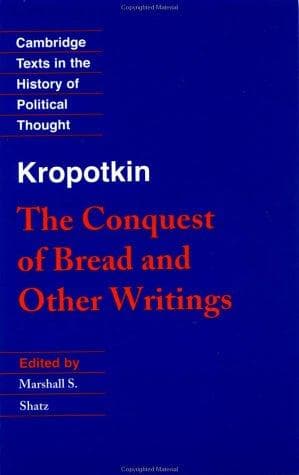
The Conquest of BreadKropotkin, Petr Alekseevich, kniaz
Philosophy
The Conquest of Bread
Kropotkin, Petr Alekseevich, kniaz
Anarchism; Communism
If you enter a modern coal-mine you will see a man in charge of a huge
machine that raises and lowers a cage. In his hand he holds a lever that
stops and reverses the course of the machine; he lowers it and the cage
reverses its course in the twinkling of an eye; he sends it upwards or
downwards into the depths of the shaft with a giddy swiftness. All
attention, he follows with his eyes fixed on an indicator which shows
him, on a small scale, at which point of the shaft the cage is at each
second of its progress; and as soon as the indicator has reached a
certain level, he suddenly stops the course of the cage, not a yard
higher nor lower than the required spot. And no sooner have the colliers
unloaded their coal-wagonettes, and pushed empty ones instead, than he
reverses the lever and again sends the cage back into space.
During eight or ten consecutive hours every day he must keep the same
strain of attention. Should his brain relax for a moment, the cage would
inevitably strike against the gear, break its wheels, snap the rope,
crush men, and put a stop to all work in the mine. Should he waste three
seconds at each touch of the lever,--the extraction, in our modern,
perfected mines, would be reduced from twenty to fifty tons a day.
Is it he who is the most necessary man in the mine? Or, is it perhaps
the boy who signals to him from below to raise the cage? Is it the miner
at the bottom of the shaft, who risks his life every instant, and who
will some day be killed by fire-damp? Or is it the engineer, who would
lose the layer of coal, and would cause the miners to dig on rock by a
simple mistake in his calculations? Or is it the mine owner who has put
his capital into the mine, and who has perhaps, contrary to expert
advice, asserted that excellent coal would be found there?
All those who are engaged in the mine contribute to the extraction of
coal in proportion to their strength, their energy, their knowledge,
their intelligence, and their skill. And we may say that all have the
right to _live_, to satisfy their needs, and even their whims, when the
necessaries of life have been secured for all. But how can we appraise
the work of each one of them?
And, moreover, Is the coal they have extracted entirely _their_ work?
Is it not also the work of the men who have built the railway leading to
the mine and the roads that radiate from all the railway stations? Is it
not also the work of those that have tilled and sown the fields,
extracted iron, cut wood in the forests, built the machines that burn
coal, slowly developed the mining industry altogether, and so on?
Public-domain text, read in full here on John Shaqi.
Reviews
Reviews
No reviews yet
Be the first to share your thoughts on this work.
Elsewhere in the archive
Join the Discussion
Join the discussion
Sign in to leave a comment or review.
Sign InorCreate an account