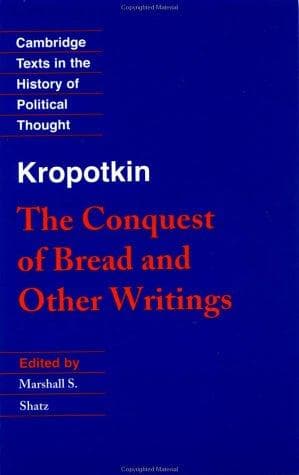
The Conquest of BreadKropotkin, Petr Alekseevich, kniaz
Philosophy
The Conquest of Bread
Kropotkin, Petr Alekseevich, kniaz
Anarchism; Communism
It is not a surplus of coal that England sends to the four corners of
the globe, because only three-quarters of a ton, per head of population,
annually, remains for home domestic consumption, and millions of
Englishmen are deprived of fire in the winter, or have only just enough
to boil a few vegetables. In fact, setting aside useless luxuries, there
is in England, which exports more than any other country, one single
commodity in universal use--cottons--whose production is sufficiently
great to _perhaps_ exceed the needs of the community. Yet when we look
upon the rags that pass for wearing apparel worn by over a third of the
inhabitants of the United Kingdom, we are led to ask ourselves whether
the cottons exported would not, on the whole, suit the _real_ needs of
the population?
As a rule it is not a surplus that is exported, though it may have been
so originally. The fable of the barefooted shoemaker is as true of
nations as it was formerly of individual artisans. We export the
_necessary_ commodities. And we do so, because the workmen cannot buy
with their wages what they have produced, _and pay besides the rent and
interest to the capitalist and the banker_.
Not only does the ever-growing need of comfort remain unsatisfied, but
the strict necessities of life are often wanting. Therefore, "surplus
production" does _not_ exist, at least not in the sense given to it by
the theorists of Political Economy.
Taking another point--all economists tell us that there is a well-proved
law: "Man produces more than he consumes." After he has lived on the
proceeds of his toil, there remains a surplus. Thus, a family of
cultivators produces enough to feed several families, and so forth.
For us, this oft-repeated sentence has no sense. If it meant that each
generation leaves something to future generations, it would be true;
thus, for example, a farmer plants a tree that will live, maybe, for
thirty, forty, or a hundred years, and whose fruits will still be
gathered by the farmer's grandchildren. Or he clears a few acres of
virgin soil, and we say that the heritage of future generations has been
increased by that much. Roads, bridges, canals, his house and his
furniture are so much wealth bequeathed to succeeding generations.
But this is not what is meant. We are told that the cultivator produces
more than he _need_ consume. Rather should they say that, the State
having always taken from him a large share of his produce for taxes, the
priest for tithe, and the landlord for rent, a whole class of men has
been created, who formerly consumed what they produced--save what was
set aside for unforeseen accidents, or expenses incurred in
afforestation, roads, etc.--but who to-day are compelled to live very
poorly, from hand to mouth, the remainder having been taken from them by
the State, the landlord, the priest, and the usurer.
Public-domain text, read in full here on John Shaqi.
Reviews
Reviews
No reviews yet
Be the first to share your thoughts on this work.
Elsewhere in the archive
Join the Discussion
Join the discussion
Sign in to leave a comment or review.
Sign InorCreate an account