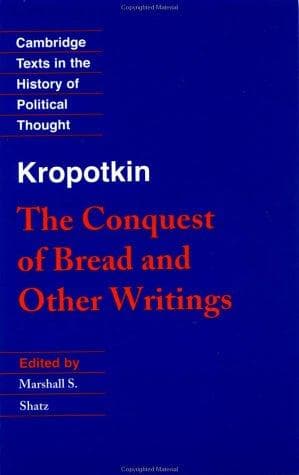
The Conquest of BreadKropotkin, Petr Alekseevich, kniaz
Philosophy
The Conquest of Bread
Kropotkin, Petr Alekseevich, kniaz
Anarchism; Communism
What they have done for individuals, they also wanted to do for nations.
Humanity was to be divided into national workshops, having each its
speciality. Russia, we were taught, was destined by nature to grow corn;
England to spin cotton; Belgium to weave cloth; while Switzerland was to
train nurses and governesses. Moreover, each separate city was to
establish a specialty. Lyons was to weave silk, Auvergne to make lace,
and Paris fancy articles. In this way, economists said, an immense field
was opened for production and consumption, and in this way an era of
limitless wealth for mankind was at hand.
However, these great hopes vanished as fast as technical knowledge
spread abroad. As long as England stood alone as a weaver of cotton and
as a metal-worker on a large scale; as long as only Paris made artistic
fancy articles, etc., all went well, economists could preach the
so-called division of labour without being refuted.
But a new current of thought induced bye and bye all civilized nations
to manufacture for themselves. They found it advantageous to produce
what they formerly received from other countries, or from their
colonies, which in their turn aimed at emancipating themselves from the
mother-country. Scientific discoveries universalized the methods of
production, and henceforth it was useless to pay an exorbitant price
abroad for what could easily be produced at home. And now we see already
that this industrial revolution strikes a crushing blow at the theory of
the division of labour which for a long time was supposed to be so
sound.
CHAPTER XVI
THE DECENTRALIZATION OF INDUSTRY[10]
I
After the Napoleonic wars Britain had nearly succeeded in ruining the
main industries which had sprung up in France at the end of the
preceding century. She also became mistress of the seas and had no
rivals of importance. She took in the situation, and knew how to turn
its privileges and advantages to account. She established an industrial
monopoly, and, imposing upon her neighbours her prices for the goods she
alone could manufacture, accumulated riches upon riches.
But as the middle-class Revolution of the eighteenth century had
abolished serfdom and created a proletariat in France, French industry,
hampered for a time in its flight, soared again, and from the second
half of the nineteenth century France ceased to be a tributary of
England for manufactured goods. To-day she too has grown into a nation
with an export trade. She sells far more than sixty million pounds'
worth of manufactured goods, and two-thirds of these goods are fabrics.
The number of Frenchmen working for export or living by their foreign
trade, is estimated at three millions.
Public-domain text, read in full here on John Shaqi.
Reviews
Reviews
No reviews yet
Be the first to share your thoughts on this work.
Elsewhere in the archive
Join the Discussion
Join the discussion
Sign in to leave a comment or review.
Sign InorCreate an account