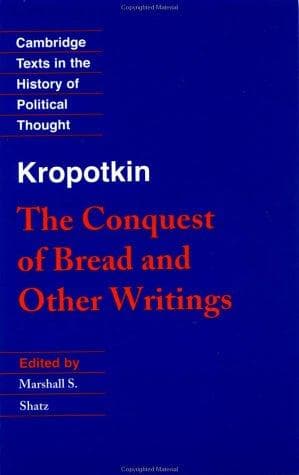
The Conquest of BreadKropotkin, Petr Alekseevich, kniaz
Philosophy
The Conquest of Bread
Kropotkin, Petr Alekseevich, kniaz
Anarchism; Communism
We all know the theory: the great European nations need colonies, for
colonies send raw material--cotton fibre, unwashed wool, spices, etc.,
to the mother-land. And the mother-land, under pretense of sending them
manufactured wares, gets rid of her damaged stuffs, her machine
scrap-iron and everything which she no longer has any use for. It costs
her little or nothing, and none the less the articles are sold at
exorbitant prices.
Such was the theory--such was the practice for a long time. In London
and Manchester fortunes were made, while India was being ruined. In the
India Museum in London unheard of riches, collected in Calcutta and
Bombay by English merchants, are to be seen.
But other English merchants and capitalists conceived the very simple
idea that it would be more expedient to exploit the natives of India by
making cotton-cloth in India itself, than to import from twenty to
twenty-four million pounds' worth of goods annually.
At first a series of experiments ended in failure. Indian
weavers--artists and experts in their own craft--could not inure
themselves to factory life; the machinery sent from Liverpool was bad;
the climate had to be taken into account; and merchants had to adapt
themselves to new conditions, now fully mastered, before British India
could become the menacing rival of the Mother-land she is to-day.
She now possesses more than 200 cotton-mills which employ about 230,000
workmen, and contain more than 6,000,000 spindles and 80,000 looms, and
40 jute-mills, with 400,000 spindles. She exports annually to China, to
the Dutch Indies, and to Africa, nearly eight million pounds' worth of
the same white cotton-cloth, said to be England's specialty. And while
English workmen are often unemployed and in great want, Indian women
weave cotton by machinery, for the Far East at wages of six-pence a day.
In short, the intelligent manufacturers are fully aware that the day is
not far off when they will not know what to do with the "factory hands"
who formerly wove cotton-cloth for export from England. Besides which it
is becoming more and more evident that India will no import a single ton
of iron from England. The initial difficulties in using the coal and the
iron-ore obtained in India have been overcome; and foundries, rivalling
those in England, have been built on the shores of the Indian Ocean.
Colonies competing with the mother-land in its production of
manufactured goods, such is the factor which will regulate economy in
the twentieth century.
And why should India not manufacture? What should be the hindrance?
Capital?--But capital goes wherever there are men, poor enough to be
exploited. Knowledge? But knowledge recognizes no national barriers.
Technical skill of the worker?--No. Are, then, Hindoo workmen inferior
to the hundreds of thousands of boys and girls, not eighteen years old,
at present working in the English textile factories?
II
Public-domain text, read in full here on John Shaqi.
Reviews
Reviews
No reviews yet
Be the first to share your thoughts on this work.
Elsewhere in the archive
Join the Discussion
Join the discussion
Sign in to leave a comment or review.
Sign InorCreate an account