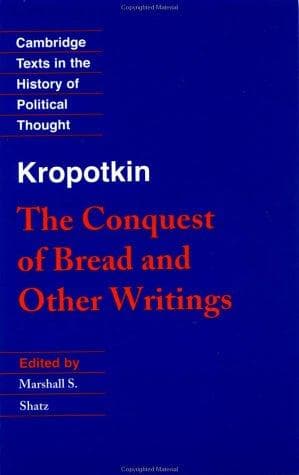
The Conquest of BreadKropotkin, Petr Alekseevich, kniaz
Philosophy
The Conquest of Bread
Kropotkin, Petr Alekseevich, kniaz
Anarchism; Communism
The day Paris has understood that to know what you eat and how it is
produced, is a question of public interest; the day when everybody will
have understood that this question is infinitely more important than all
the parliamentary debates of the present times--on that day the
Revolution will be an accomplished fact. Paris will take possession of
the two departments and cultivate them. And then the Parisian worker,
after having laboured a third of his existence in order to buy bad and
insufficient food, will produce it himself, under his walls, within the
enclosure of his forts (if they still exist), and in a few hours of
healthy and attractive work.
And now we pass on to fruit and vegetables. Let us go outside Paris and
visit the establishment of a market-gardener who accomplishes wonders
(ignored by learned economists) at a few miles from the academies.
Let us visit, suppose, M. Ponce, the author of a work on
market-gardening, who makes no secret of what the earth yields him, and
who has published it all along.
M. Ponce, and especially his workmen, work like niggers. It takes eight
men to cultivate a plot a little less than three acres (2.7). They work
twelve and even fifteen hours a day, that is to say, three times more
than is needed. Twenty-four of them would not be too many. To which M.
Ponce will probably answer that as he pays the terrible sum of £100 rent
a year for his 2.7 acres of land, and £100 for manure bought in the
barracks, he is obliged to exploit. He would no doubt answer, "Being
exploited, I exploit in my turn." His installation has also cost him
£1,200, of which certainly more than half went as tribute to the idle
barons of industry. In reality, this establishment represents at most
3,000 work-days, probably much less.
But let us examine his crops: nearly ten tons of carrots, nearly ten
tons of onions, radishes, and small vegetables, 6,000 heads of cabbage,
3,000 heads of cauliflower, 5,000 baskets of tomatoes, 5,000 dozen of
choice fruit, 154,000 salads; in short, a total of 123 tons of
vegetables and fruit to 2.7 acres--120 yards long by 109 yards broad,
which makes more than forty-four tons of vegetables to the acre.
But a man does not eat more than 660 pounds of vegetables and fruit a
year, and two and one-half acres of a market-garden yield enough
vegetables and fruit to richly supply the table of 350 adults during the
year. Thus twenty-four persons employed a whole year in cultivating 2.7
acres of land, and only five working hours a day, would produce
sufficient vegetables and fruit for 350 adults, which is equivalent at
least to 500 individuals.
To put it another way: in cultivating like M. Ponce--and his results
have already been surpassed--350 adults should each give a little more
than 100 hours a year (103) to produce vegetables and fruit necessary
for 500 people.
Public-domain text, read in full here on John Shaqi.
Reviews
Reviews
No reviews yet
Be the first to share your thoughts on this work.
Elsewhere in the archive
Join the Discussion
Join the discussion
Sign in to leave a comment or review.
Sign InorCreate an account