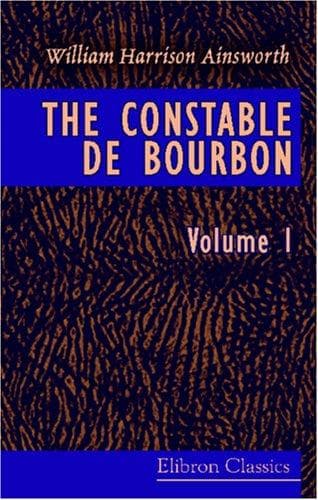
The Constable De BourbonAinsworth, William Harrison
General
The Constable De Bourbon
Ainsworth, William Harrison
Bourbon, Charles, duc de, 1490-1527 -- Fiction
Meanwhile, the king had thrown himself into the thickest of the fight.
His lance having long since been broken, he had drawn his trenchant
sword, and, like a paladin of old, dealt blows right and left, and did
not refuse a hand-to-hand combat when offered him.
Already, as we have shown, he had slain Castrioto, and now several
others fell by his hand. Among them was a knight from the Franche Comté,
named Andelot, with whom François had a long conflict.
While drawing breath after this encounter, he heard shouts on the
right, and, turning at the sound, beheld the flying bands of the Swiss
mercenaries.
“Great Heavens!” he exclaimed, in mingled amazement and indignation,
“what means that rush of men?”
“The Swiss are retreating, sire--shamefully retreating--almost without
a blow,” rejoined Bonnivet, who was near him.
“Ha, dastards! ha, traitors! do they desert me thus!” cried the king,
furiously. “Come with me, Bonnivet.”
And spurring his steed, he dashed after the flying Swiss, striving to
rally them, but his efforts were in vain.
At the same juncture, the Duke d'Alençon, alarmed by the destruction
of the Black Bands, the rout of the right wing, and the disorder of the
main body, sounded a retreat, and withdrew ingloriously from the field.
Vainly did La Roche du Maine, his lieutenant, and the Baron de Trans,
try to turn him from his fatal resolution. Finding him immovable, they
threw themselves into the main body, towards which the efforts of the
enemy were now directed.
Once more the lion-hearted king made a tremendous charge against the
Spanish cavalry, led on by Pescara. For a moment it seemed as if
this charge would turn the tide of victory, so great was the havoc it
occasioned. Pescara himself was wounded by a sword-cut in the cheek,
stricken from his steed, and trampled under foot by the enemy. With
difficulty he was rescued by his men, and dragged out of the way. Lannoy
again brought on his Neapolitans, and was repulsed with heavy loss.
The battle now raged furiously, and the din of arms Was as if a thousand
smiths were at work, mingled with the rattle of arquebusses, the shrieks
of wounded horses, and the shouts, curses, and groans of the combatants.
Terrible was the carnage. On all sides could be seen the bravest and
noblest of the French chivalry flocking towards the king's standard,
resolved to win the day or perish with him, for his actions showed that
he would never retire.
But the decisive moment had come. Pescara was down, and severely wounded
as we have seen, and his squadron shattered by the last charge of the
king. Lannoy, who had advanced to sustain him, was likewise repulsed.
For a brief space the heroic king persuaded himself that he could
retrieve his losses, but his exultation was speedily quelled. He saw a
dense dark mass gathering in front that threatened to overwhelm him.
Public-domain text, read in full here on John Shaqi.
Reviews
Reviews
No reviews yet
Be the first to share your thoughts on this work.
Elsewhere in the archive
Join the Discussion
Join the discussion
Sign in to leave a comment or review.
Sign InorCreate an account