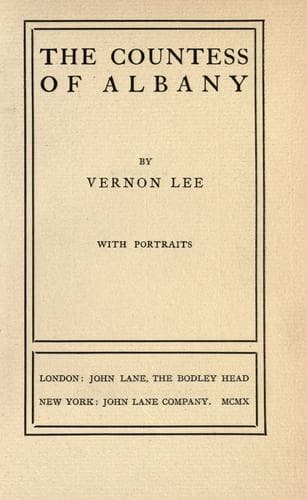
Albany, Louise Maximiliane Caroline Emanuele, Princess of Stolberg-Gedern, calling herself Countess of, 1752-1824
man's head, could only increase. To feel himself at a disadvantage on
account of his very virtues, and with people whom those virtues did
not impress, must have been most intolerable to a man as vain and
self-conscious as Alfieri, and to this was added the sense that,
from mere ignorance of the language (the language whose nobility, as
contrasted with the "low, plebeian, nasal disgustingness" of French, he
so often descanted on) in which he wrote, it was quite impossible for
these people to be reduced to their right place and right mind by the
crushing superiority of his dramatic genius. He, who hungered and
thirsted for glory, what glory could he hope for among all these monkeys
of Frenchmen, jabbering and gesticulating about their States-General,
their Montgolfier, their St. Pierre, their Condorcet, their Parny, their
Necker, who had not even the decent feeling to know Italian, and who
bowed and smiled and doubtless mixed him up with Metastasio and Goldoni
when introduced by the Countess to so odd a piece of provincialism as an
Italian poet. "Does Monsieur write comedies or tragedies?" One fancies
one can hear the politely indifferent question put with a charming
smile by some powdered and embroidered French wit to Mme. d'Albany in
Alfieri's hearing; nay, to Alfieri himself.
Mixed with such meaner, though unconscious motives for dissatisfaction,
must have been the sense, intolerable to a man like Alfieri, of the
horrid and grotesque jumble of good and bad, of real and false, not
merely in the revolutionary movement itself, but in all these men of the
_ancien regime_ who initiated it. Alfieri conceived liberty from the
purely antique, or, if you prefer, pseudo-antique, point of view; it
was to him the final cause of the world; the aim of all struggles; to
be free was the one and only desideratum, to be master of one's own
thoughts, actions, and words, merely for the sake of such mastery. The
practical advantages of liberty entirely escaped him, as did the
practical disadvantages of tyranny; nay, one can almost imagine that
had liberty involved absolute misery for all men, and tyranny absolute
happiness, Alfieri would have chosen liberty. To this pseudo-Roman
and intensely patrician stoic, who had never known privation or
injustice towards himself, and scarcely noticed it towards others,
the humanitarian, the philanthropic movement, characteristic of the
eighteenth century, and which was the strong impulse of the revolution,
was absolutely incomprehensible. Alfieri was, in the sense of certain
ancients, a hard-hearted man, indifferent, blind and deaf to suffering.
That a man of education and mind, a gentleman, should have to sweep the
ground with his hat on the passage of another man, because that other
happened to wear a ribbon and a star; that he should be liable to exile,
to imprisonment, for a truthful statement of his opinion: these were to
Alfieri the insupportable things of tyranny. But that a man in wooden
Public-domain text, read in full here on John Shaqi.
Reviews
Reviews
No reviews yet
Be the first to share your thoughts on this work.
Elsewhere in the archive
Join the Discussion
Join the discussion
Sign in to leave a comment or review.
Sign InorCreate an account