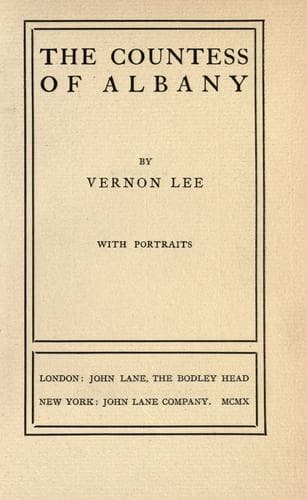
Albany, Louise Maximiliane Caroline Emanuele, Princess of Stolberg-Gedern, calling herself Countess of, 1752-1824
A shadowy being, nay, a shadow cast in the unmistakable shape of
another, so long as Alfieri was alive, the Countess of Albany seems to
gain consistency and form, to become a substantive person, only after
Alfieri's death. This woman, whom, in the last ten years, we have seen
consorting almost exclusively with Italians, and spending the greater
proportion of her days in solitary reading of Condillac, Lock, Kant,
Mme. de Genlis, Lessing, Milton, everything and anything; whose letters,
exclusively (as far as I know them) to Italians of the middle classes,
are full of fury against everything that is French; this woman, who has
hitherto been a feeble replica of Alfieri, suddenly turns into an
extremely sociable, chatty woman of the world, and a woman of the world
who is, to all intents and purposes, French.
To be the rallying point of a very cosmopolitan, literary, but by no
means unworldly society, seems suddenly to have become Mme. d'Albany's
mission; and reading the letters copied from the Montpellier Archives,
and published by M. Saint Rene Taillandier, one wonders how this friend
of Mme. de Stael, of Sismondi, of Mme. de Souza, this hostess of Moore,
of Lamartine, of Lady Morgan, of every sort of French, English, German,
Russian, or polyglot creature of distinction that travelled through
Italy in the early part of this century, could ever have been the
beloved of Alfieri, the misanthropic correspondent of a lot of Sienese
professors, priests, and shop-keepers.
The fact was that Mme. d'Albany could now become, so to speak, what she
really was; or, at least, show herself to be such. Worldly wise and a
trifle cynical she had always been; in the midst of the pages of literary
review and political newspaper constituting her letters to Mme. Mocenni,
Canon Luti and Alessandro Cerretani of Siena, there is a good deal of
mere personal gossip, stories of married women's lovers, married men's
mistresses, domestic bickerings, &c., interspersed with very plain-spoken
and (according to our ideas) slightly demoralised moralisings. It is
evident that this was not a woman to shrink from the reality of things,
to take the world in disgust, to expect too much of her acquaintances.
On the other hand these letters of the Alfieri period show Mme. d'Albany
to have been decidedly a good-natured and friendly woman. She has the
gift of getting people to trust her with their little annoyances and
grievances; she is constantly administering sympathy to Mme. Mocenni
for the tiresomeness and stupidity and harshness of her husband; she
keeps up a long correspondence, recommending books, correcting French
exercises, exhorting to study and to virtue (particularly to abstinence
from gambling), encouraging, helping Mme. Mocenni's boy Vittorio. She is
clearly a woman who enjoys hearing about other folk's concerns, enjoys
taking an interest in them, sympathising and, if possible, assisting
them.
Public-domain text, read in full here on John Shaqi.
Reviews
Reviews
No reviews yet
Be the first to share your thoughts on this work.
Elsewhere in the archive
Join the Discussion
Join the discussion
Sign in to leave a comment or review.
Sign InorCreate an account