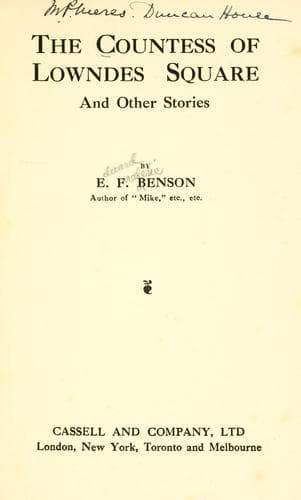
The Countess of Lowndes Square, and Other StoriesBenson, E. F. (Edward Frederic)
General
The Countess of Lowndes Square, and Other Stories
Benson, E. F. (Edward Frederic)
English fiction -- 20th century; Short stories, English
“I know we didn’t, but there always seemed a possibility. The door was
ajar; it wasn’t locked, and it has never ceased to be ajar. Often when
the mere thought-reading, as you call it, is flowing along most
smoothly, I feel that if only I could abandon my whole consciousness a
little more completely, something, somebody would really take control of
me. I wish it would; and yet I’m frightened of it. It might revenge
itself for all the frauds I’ve perpetrated in its name. Come, let’s play
piquet and forget about it all.”
* * * * *
It was settled that Julia should be present next day when the stranger
came for her sitting, in order that if Richard’s thought-reading was not
coming through any better than it had done lately, she should help in
the rappings and the luminous patches and the musical box. Mrs. Gardner
was punctual to her appointment, a tall, quiet, well-dressed woman who
stated with perfect frankness her object in wishing for a séance and her
views about spirit-communication.
“I should immensely like to believe in spirit-communication,” she said,
“such as I am told you are capable of producing; but at present I
don’t.”
“It is important that the atmosphere should not be one of hostility,”
said Waghorn in his dreamy, professional manner.
“I bring no hostility,” she said. “I am in a state, shall we say, of
benevolent neutrality, unless”--and she smiled in a charming
manner--“unless benevolent neutrality has come to mean malevolent
hostility. That, I assure you, is not the case with me. I want to
believe.” She paused a moment.
“And may I say this without offence?” she asked. “May I tell you that
spirit-rappings and curious lights and sounds of music do not interest
me in the least?”
They were already seated in the room where the séance was to be held.
The windows were thickly curtained, there was only a glimmer of light
from the red lamp, and even this the spirits would very likely desire to
have extinguished. If this visitor took no interest in such things,
Waghorn felt that he and his sister had wasted their time in adjusting
the electric hammer (made to rap by the pressure of the foot on a switch
concealed in the thick rug underneath the table) behind the
sliding-panel, in stringing across the ceiling the invisible wires on
which the luminous globes ran, and in making ready all the auxiliary
paraphernalia in case the genuine telepathy was not on tap. So with
voice dreamier than before and with slower utterance as he was supposed
to be beginning to sink into trance, he just said:
“I can’t foretell the manner in which they may choose to make their
presence known.”
Public-domain text, read in full here on John Shaqi.
Reviews
Reviews
No reviews yet
Be the first to share your thoughts on this work.
Elsewhere in the archive
Join the Discussion
Join the discussion
Sign in to leave a comment or review.
Sign InorCreate an account