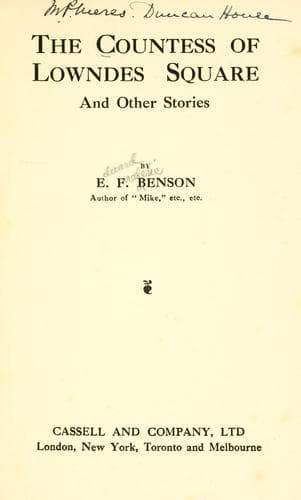
The Countess of Lowndes Square, and Other StoriesBenson, E. F. (Edward Frederic)
General
The Countess of Lowndes Square, and Other Stories
Benson, E. F. (Edward Frederic)
English fiction -- 20th century; Short stories, English
Puss-cat, without doubt, was a plain kitten; but again, like many
children of our own inferior race, she grew up to be a very handsome
cat. With great chic she did not attempt colours, but was pure black and
white. Across her broad, strong back there was a black saddle, but the
saddle, so to speak, had slewed round and made a black band across her
left side. There was an arbitrary patch of black, too, on her left
cheek, a black band on her tail, and a black tip to it. Otherwise she
was pure white, except when she put out a pink tongue below her long,
snowy whiskers. But her charm--the outstanding feature of Puss-cat--was
independent of this fascinating colouring. Martha, for instance, had
been content that dishes were carried into the dining-room, and
subsequently carried out. That and no more was her notion of her duties
towards dinner. But Puss-cat really began where Martha ended. Like her,
she preceded the soup, but when those who were present had received
their share, she always went round with loud purrings to each guest, to
congratulate them and hope that they liked it. For this process, which
was repeated with every dish, she had a particular walk, stepping high
and treading on the tips of her toes. This congratulatory march was
purely altruistic: she did not want soup herself; she was only glad that
other people had got it. Then when fish came, or bird, she would make
her congratulatory tour just the same, and then sit firmly down and say
she would like some too. Occasionally she favoured some particular guest
with marked regard, and sometimes almost forgot her duties as mistress
of the house, choosing rather to sit by her _protégée_ and purr loudly,
so that a dish would already be half-eaten before she went her round to
see that everyone was pleased with his portion. Finally, when coffee was
brought, she went downstairs to the kitchen and retired for the night,
usually sharing Jill’s basket, where they lay together in a soft
slow-breathing heap of black and white.
Puss-cat, like the ancient Greeks, was never sick or sorry; never sick,
because of her robust and stalwart health; never sorry, because she
never did anything to be sorry for. From living with Jill, and never
seeing a cat, except for those short and painful interviews which
preceded expulsion from the garden, she grew to have something of the
selfless affection of a dog, and when I came home after an absence she
would run out into the street to meet me, stiff-tailed, and really not
attending to the debarkation of luggage, but intent only on welcoming me
home. Eight busy, happy years passed thus, and then one bitter February
morning, Pussy-cat disappeared.
* * * * *
Public-domain text, read in full here on John Shaqi.
Reviews
Reviews
No reviews yet
Be the first to share your thoughts on this work.
Elsewhere in the archive
Join the Discussion
Join the discussion
Sign in to leave a comment or review.
Sign InorCreate an account