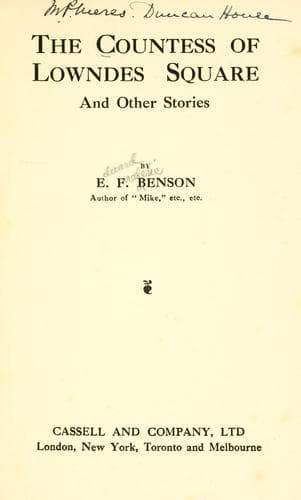
The Countess of Lowndes Square, and Other StoriesBenson, E. F. (Edward Frederic)
General
The Countess of Lowndes Square, and Other Stories
Benson, E. F. (Edward Frederic)
English fiction -- 20th century; Short stories, English
By degrees, this particular figure, standing in royal state alone behind
the plate-glass window in Regent Street, began to exercise a controlling
influence on his imagination, and he would hurry by the rows of shops
which lay on his route without constructing independent romances out of
the hints they gave him, and only glancing at them to see what
suggestions they supplied as regards _Her_. He gave her, for instance,
the tiara which he had worn when he was queen in his own right; he
presented her with some lemon-coloured gloves that reached to her elbow;
he bought her daffodils from Piccadilly Circus; and, rather more
tentatively, he endowed her with a black hat with Gloire-de-Dijon roses
in it; and standing there in front of her, he would hold up to his nose
the handkerchief on which he had poured wallflower scent, which he was
sure she would use, and inhale a sweetness that really seemed to come
from her through the plate-glass window. All other shops which could not
contribute to her embellishment became uninteresting again, and once
more he would hurry with held breath past the fishmonger, for if was
clearly unsuitable to present her with kippers, raw salmon, or even live
lobsters. Then, standing a little sideways, not directly in front of
her, her eyes met his, and though usually they seemed lost in reverie,
occasionally they would meet his own in a way that sent his heart
thumping in his throat. Always she wore the same faint, unfathomable
smile, reminding him of Leonardo’s “Monna Lisa,” and it seemed to him
that the reason for which Nature had brought him into the world was that
he should penetrate into the thoughts that set that red mouth so
deliciously ajar. It must surely be on his own lips that it would
close.... Her loveliness, while she was kind, made the whole world
lovely to him, and his whole nature seemed to awake.
His constant day-long walks about London had wonderfully improved his
health; he no longer feared the sun and the wind, and got quite bronzed
in complexion. Still more remarkable was, so to speak, the psychical
bronzing of his mind, the suntan of virility that overspread it;
everything was shot with interest for him, and he even got Alice to
show him how to work the lathe. For this was no pining and lovelorn
affection; it was quite a hopeful affair, and though, when alone, he
might sigh and turn over and back again on his bed, the brilliance and
upright carriage of the object of his adoration stung him into a manly
robustness. She would not like him to go sighing and sheltering himself
about the world.
It was no wonder that Alice noticed and applauded the change in him.
“Something has happened to you, Oliver,” she said one night at dinner,
while they were cracking walnuts together, for he had aspired to that
accomplishment, though it hurt his soft hands very much. “Something has
happened to you. I wonder if I can guess what it is?”
He felt quite secure of the secrecy of his passion, and cracked two
walnuts.
Public-domain text, read in full here on John Shaqi.
Reviews
Reviews
No reviews yet
Be the first to share your thoughts on this work.
Elsewhere in the archive
Join the Discussion
Join the discussion
Sign in to leave a comment or review.
Sign InorCreate an account