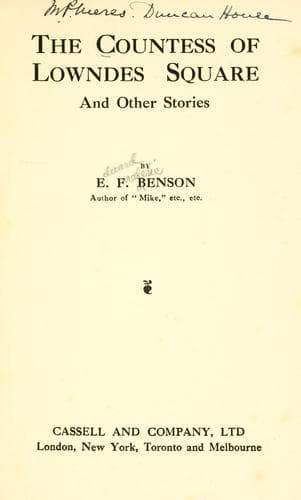
The Countess of Lowndes Square, and Other StoriesBenson, E. F. (Edward Frederic)
General
The Countess of Lowndes Square, and Other Stories
Benson, E. F. (Edward Frederic)
English fiction -- 20th century; Short stories, English
The cat had finished its toilet and jumped down again into the
herbaceous bed. Philip heard a faint mew, and his awaking imagination
told him that Tommy had cut his foot already. With a spasm of remorse he
ran out into the garden and began a frenzied search for the razor-blade
which with such culpable carelessness he had thrown away. A quarter of
an hour’s search was rewarded by its discovery, and as there was no
blood on the edge of it he thankfully assumed that he had not been
punished (nor Tommy either) for his thoughtlessness. He unfortunately
stepped on a fine calceolaria, and regained the gravel path with the
blade in his hand.
He locked it up in the drawer of his knee-hole table, where he kept his
will and his pass-book and his cheque book, and with a free mind
returned to Eva, perilously voyaging on the ice past the woods of
Richmond, and praying that she should be “in time.” But suddenly, and
for the first time in their dual and prosperous career as _feuilleton_
writers, Philip found himself finding a certain want of actuality in
Phœbe’s imaginings. They lacked the bite of such realism as he had found
illustrated in the poignancy of his own search for the discarded
razor-blade in the herbaceous border. There was emotion, real human
emotion, though only concerned with the paws of a cat and a razor,
whereas Eva’s taper fingers on the tiller of this remarkable craft
seemed to want the solidity of mortal experience. But it would never do
to lose faith in Phœbe’s inventions, for it was his faith in them that
lent him his unique skill as interpreter and chronicler of them. And,
anyhow, the razor-blade was safely inaccessible now to any cat on its
pleasure excursions, and he turned his mind back to the woods of
Richmond.
With the unexpectedness of a clock loudly chiming, his imagination began
to work again. What if he should suddenly die even as he sat there at
his table! Phœbe alone knew where his will was kept, and he saw her,
blind with tears, unlocking the drawer and groping with trembling hand
among its contents. Suddenly she would start back with a cry of pain,
and withdraw her hand, on which the fast-flowing blood denoted that she
had severed an artery or two, and would bleed to death in a few seconds,
as had happened to a most obnoxious Marquis in the tale, “Kind hearts
are more than coronets.”
Next moment he had unlocked the drawer, and gingerly holding the dread
instrument of Phœbe’s death between finger and thumb, looked wildly
round for some secure asylum for the hateful thing. Long he stood there
in hesitation; then, mounting a set of “library steps,” deposited it on
the top of the tall bookcase which held the complete file of all the
newspapers in which their tales had appeared. Then he set to work again
on Eva, who presently ran her ice-boat ashore below the Star and Garter
hotel. But half the morning had already gone, and he had scarcely yet
made a beginning of the morning’s work.
Public-domain text, read in full here on John Shaqi.
Reviews
Reviews
No reviews yet
Be the first to share your thoughts on this work.
Elsewhere in the archive
Join the Discussion
Join the discussion
Sign in to leave a comment or review.
Sign InorCreate an account