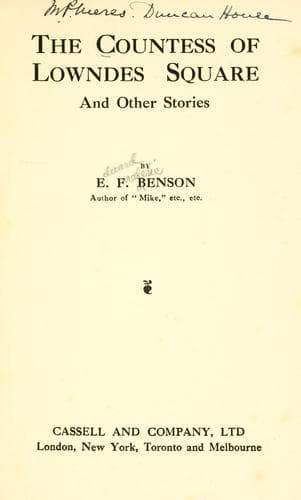
The Countess of Lowndes Square, and Other StoriesBenson, E. F. (Edward Frederic)
General
The Countess of Lowndes Square, and Other Stories
Benson, E. F. (Edward Frederic)
English fiction -- 20th century; Short stories, English
He and Phœbe had driven out in their motor-car one afternoon, and had
dismissed it two miles from home in order to have the pleasure of
walking back through the flowery lanes. Philip was something of a
botanist, and since he was now engaged on the chronicling of the
reunion of Eva and Algernon, which unexpectedly took place in a ruined
temple near Rome, he wanted to refresh his memory by the sight of the
glories of the early English summer, in order to deck the flowery fields
in which the ruined temple lay with the utmost possible lavishness of
floral tapestry.
“The ruin stands for the trial they have passed through, my dear,” he
explained to Phœbe, “and lo, all round Nature breaks into gladness!”
Phœbe gave a deep sigh.
* * * * *
“I think that’s lovely,” she said. “How you embellish my dry skeleton of
a tale, darling, covering it with strong muscles and lovely supple skin.
We _are_ happy, aren’t we? I wonder if Algernon and Eva were really as
happy, even at that moment, as we always are!”
They had come near to the stream that flowed by the bottom of the
garden, the bank of which was a tangle of flowers.
“Loosestrife, meadow-sweet, marsh-marigold, willow-herb,” said Philip.
“Delicious names, are they not?”
The sound of shrill juvenile voices was heard, and turning a bend in the
lane, they came opposite the pool where Philip had thrown the
razor-blade. There on the bank were half a dozen small boys in various
degrees of nudity, and rosy from their bathing.
“Little darlings!” said Phœbe sympathetically. “What a jolly time they
have been having in the water!”
“Willow-herb, marsh-marigold,” murmured Philip mechanically, looking
round for the traces of blood on the stream-bank....
He took a firm hold of himself, and managed to walk across the wooden
bridge that led to the bottom of the garden with some show of
steadiness. But he almost reeled and fell when, looking into the pool,
he saw the razor-blade, its encompassing envelope having been destroyed
by the water, shining on the pebbly bottom of the stream like tragic
Rhinegold.
When they had had tea, he made some lame excuse of studying flowers a
little longer and slipped down again to the stream. The boys had gone,
and taking off his shoes and socks, and rolling his trousers up to the
knee, he waded out over the sharp pebbles to where his doom flickered in
the sunshine. With the aid of his stick he propelled it into shallower
waters and picked it up. Then, shivering from the brisk water, and
tearing his socks as he pulled them over his wet feet, he returned with
it to the house in a state of more miserable dejection than Algernon had
ever been, even when he sat down on the ruins of the Roman temple,
unaware that Eva was just about to come round the corner with April in
her eyes.
Public-domain text, read in full here on John Shaqi.
Reviews
Reviews
No reviews yet
Be the first to share your thoughts on this work.
Elsewhere in the archive
Join the Discussion
Join the discussion
Sign in to leave a comment or review.
Sign InorCreate an account