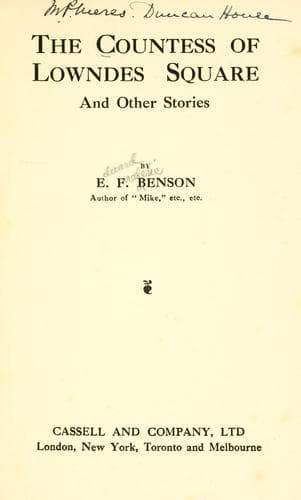
The Countess of Lowndes Square, and Other StoriesBenson, E. F. (Edward Frederic)
General
The Countess of Lowndes Square, and Other Stories
Benson, E. F. (Edward Frederic)
English fiction -- 20th century; Short stories, English
“That sounds a little far-fetched, dear,” he said, “though I quite agree
with you about the possibility of its being Pocksky who wrote through
me. I wonder who he was? Some great general, probably.”
You can easily imagine the excitement that pervaded Oakley in the weeks
that followed, when every day brought some fresh butler or railway
porter into the public press, who had told somebody who had told the
author of the letter in question that he had seen bearded soldiers
stepping out of trains with blinds drawn down, and shaking the snow off
their boots. It mattered nothing that the whole romance was officially
denied; indeed, it only made Mrs. Andrews very indignant at the
suppression of war news.
“The War Office may say what it likes,” she exclaimed, “and, indeed, it
seems to make it its business to deny what we all know to be true. I
think I must learn a few words of Russian, in case I meet any soldier
with a beard--‘God Save the Tsar!’ or something of the kind. I shall
send for a Russian grammar. Now, let us see what Pocksky has to tell us
to-night.”
That no further confirmation of Pocksky’s announcements on this subject
ever came to light was scarcely noticed by the automatic writers, for
Pocksky was bursting with other news. He rather terrified his
interpreters, when there was nervousness about possible Zeppelin raids,
by saying: “Fires from the wicked ones in the clouds. Fourteen, twelve,
fourteen, cellar best,” since this could hardly mean anything but that a
raid was to be expected on the fourteenth of December; and Mr. and Mrs.
Andrews--and, indeed, a large number of their friends--spent the evening
in their cellars, coming out again when it was definitely after
midnight. But the relief at finding that no harm had been done speedily
obliterated the feeling that Pocksky had misled them, and when, on
Christmas Eve, he said, “Spirit of Peace descends,” though certain
people thought he meant that the War would soon be over, the truce on
the Western Front for Christmas Day was more generally believed to bear
out this remarkable prophecy.
All through the spring Pocksky continued voluble. He would not
definitely commit himself over the course that Italy was to take, but,
as Mrs. Andrews triumphantly pointed out, Italy would not definitely
commit herself either, which just showed how right Pocksky was. He
rather went back to the Pocky style over this, and said: “Prudence is
better than precipitation; Italy prepares before making decision. Wisdom
guides her counsels, and wisdom is ever best. From Pocksky.”
Intermittently the forcing of the Dardanelles occupied him.
Public-domain text, read in full here on John Shaqi.
Reviews
Reviews
No reviews yet
Be the first to share your thoughts on this work.
Elsewhere in the archive
Join the Discussion
Join the discussion
Sign in to leave a comment or review.
Sign InorCreate an account