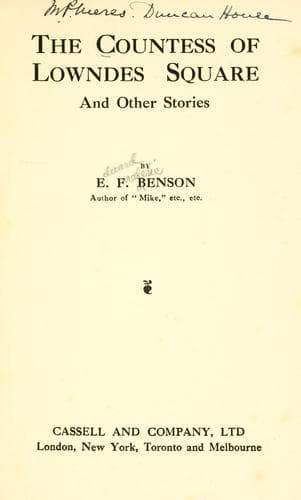
The Countess of Lowndes Square, and Other StoriesBenson, E. F. (Edward Frederic)
General
The Countess of Lowndes Square, and Other Stories
Benson, E. F. (Edward Frederic)
English fiction -- 20th century; Short stories, English
Hugh was sitting by his side in a deck-chair, idly fitting together the
two halves of the broken image. He too heard what had startled Rankin;
for it was the same noise as had startled him last night, namely, the
scampering of some great frolicsome animal, somewhere close to them. As
he jumped up, severing his hands, the noise ceased.
“Funny,” he said, “I heard that last night. There’s nothing; it’s some
stray dog in the bushes. Do tell me what it is that I’ve got.”
Rankin, who had surged to his feet also, stood listening a moment. But
there was nothing to be heard but the buzzing of bees in the bushes and
the chiding of the remote kites overhead. He sat down again.
“Well, give me two minutes,” he said, “and I can tell you all I know.
Once upon a time, when this wonderful and secret land was alive and not
dead--oh, we have killed it with our board-schools and our steamers and
our religion--there was a whole hierarchy of gods, Isis, Osiris, and the
rest, of whom we know a great deal. But below them there was a company
of semi-divinities, demons if you will, of whom we know practically
nothing. The cat was one, certain dwarfish creatures were others, but
most potent of all were the cynocephali, the dog-faced apes. They were
not divine, rather they were demons, of hideous power, _but_”--and he
pointed a great hand at Hugh--“they could be controlled. Men could
control them, men could turn them into terrific servants, much as the
genii in the ‘Arabian Nights’ were controlled. But to do that you had to
know the secret name of the demon, and had yourself to make an image of
him, with the secret name inscribed thereon, and by that you could
summon him and all the incarnate creatures of his species.
“So much we know from certain very guarded allusions in the Book of the
Dead and other sources, for this was one of the great mysteries never
openly spoken of. Here and there a priest in Karnak, or Abydos, or in
Hieropolis, had had handed down to him one of those secret names, but in
nine cases out of ten the knowledge died with him, for there was
something dangerous and terrible about it all. Old Abdul here, for
instance, believes that Moses had the secret names of frogs and lice,
and made images of them with the secret name inscribed on them, and by
those produced the plagues of Egypt. Think what you could do, think what
he did, if infinite power over frog-nature were given you, so that the
king’s chamber swarmed with frogs at your word. Usually, as I said, the
secret name was but sparingly passed on, but occasionally some very bold
advanced spirit, such as Moses, made his image, and controlled----”
Public-domain text, read in full here on John Shaqi.
Reviews
Reviews
No reviews yet
Be the first to share your thoughts on this work.
Elsewhere in the archive
Join the Discussion
Join the discussion
Sign in to leave a comment or review.
Sign InorCreate an account