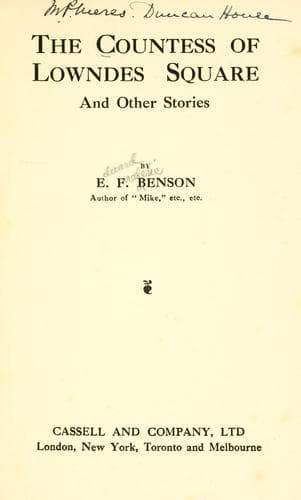
The Countess of Lowndes Square, and Other StoriesBenson, E. F. (Edward Frederic)
General
The Countess of Lowndes Square, and Other Stories
Benson, E. F. (Edward Frederic)
English fiction -- 20th century; Short stories, English
Rather puzzled and vaguely uncomfortable, Hugh went into the hotel. It
was true that he had told her he had letters that should have been
written a week ago, but something at the back of his mind insisted that
this was not the girl’s real reason for wanting him to do his task now.
She wanted to go and meet the boat alone, and on the moment an unfounded
jealousy stirred like a coiled snake in him. He told himself that it
might be some inconvenient aunt whom she was going to meet, but such a
suggestion did not in the least satisfy him when he remembered the
obvious pleasure with which she had read the telegram that no doubt
announced this arrival. But he nailed himself to his writing-table till
a couple of very tepid letters were finished, and then, with growing
restlessness, went out through the hall into the warm, still night. Most
of the hotel had gone indoors to dress for dinner, but sitting on the
veranda with her back to him was Julia. A chair was drawn in front of
her, and facing her was a young man, on whose face the light shone. He
was looking eagerly at her, and his hand rested on her knee. Hugh turned
abruptly and went back into the hotel.
He and Julia for these last three days had, with two other friends, made
a very pleasant party of four at lunch and dinner. To-night, when he
entered the dining-room, he found that places were laid here for three
only, and that at a far-distant table in the window were sitting Julia
and the young man whom he had seen with her on the veranda. His identity
was casually disclosed as dinner went on; one of his companions had seen
Lord Paterson in Cairo. Hugh had only a wandering ear for table-talk,
but a quick glancing eye, ever growing more sombre, for those in the
window, and his heavy face, as he noted the tokens and signs of their
intimacy, grew sullen and savage. Then, before dinner was over, they
rose and passed out into the garden.
Jealousy can no more bear to lose sight of those to whom it owes its
miseries than love can bear to be parted from the object of its
adoration, and presently Hugh and his two friends went and sat, as was
usual with them, on the veranda outside. Here and there about the garden
were wandering couples, and in the light of the full moon, which was to
be their lamp at Karnak to-night when the “tiresome people” had gone, he
soon identified Julia and Lord Paterson. They passed and repassed down a
rose-embowered alley, hidden sometimes behind bushes and then appearing
again for a few paces, and each sight of them, each vanishing of them
again served but to confirm that which already needed no confirmation.
And as his jealousy grew every moment more bitter, so every moment Hugh
grew more and more dangerously enraged. Apparently Lord Paterson was not
one of the “tiresome people” whom Julia longed to get away from.
Public-domain text, read in full here on John Shaqi.
Reviews
Reviews
No reviews yet
Be the first to share your thoughts on this work.
Elsewhere in the archive
Join the Discussion
Join the discussion
Sign in to leave a comment or review.
Sign InorCreate an account