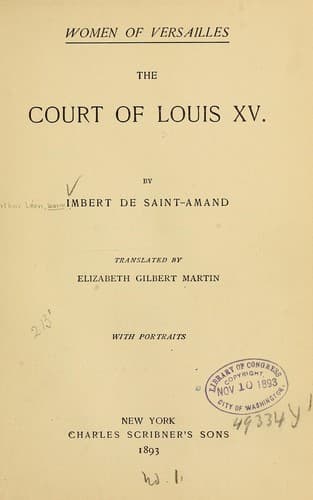
France -- Court and courtiers; France -- History -- Louis XV, 1715-1774
Pompadour, Marquise de, 1, 6;
her character, 116, 117;
her birth and early life, 117;
her accomplishments, 117;
her marriage, 118;
President Hénault’s words concerning, 118;
plans to capture the fancy of Louis XV., 119;
appears as Diana at the Hôtel de Ville ball, 119, 120;
her children, 120;
makes her way into Versailles, 120, 121;
concealed by Louis XV., 121;
withdraws to her chateau at Étioles, 122;
receives title of Marquise, 124;
her presentation, 125;
treatment of her by the court, 127;
her attitude toward the Queen, 127–129;
her theatre of the little Cabinets, 132 _et seq._;
her fear of losing the interest of the King, 133;
her successes as an actress, 132, 134, 139, 140, 142, 145;
wants to play comedy at Versailles, 135;
draws up regulations for players at her theatre, 137, 138;
plays and sings, 139;
in the ballet of _Almases_, 140;
her last performance, 146;
Rousseau’s letter to, 146;
her power, pomp, and opulence, 147 _et seq._;
her sepulchre, 149;
her beauty, 149, 150;
what she cost France, 150;
her dwellings and apartments, 150–152;
verses to, by Voltaire, 122–124, 145, 152–154;
her griefs and sadness, 156 _et seq._;
threatened with death, 157;
insulted by Madame de Coaslin, 157;
her lack of confidence in the King, 156, 158;
like Scheherezade, 158;
her desire to marry her daughter Alexandrine, 160–162;
death of her daughter Alexandrine, 160;
verses at death of her mother, 160;
Sainte-Beuve’s words concerning, 161;
Paris implacable towards, 162;
verses abusing her, 163–166;
suffers under public abuse, 167;
ready to do anything to hold her place, 168;
makes a show of devotion, 168–170, 173;
has a statue made of herself, 170;
is attacked by fever, 170;
her feeling of insecurity, 170, 171;
endeavors to obtain absolution from the Jesuits, 173, 174;
refused absolution by Père de Sarcy, 174, 175;
solicits a place as lady of the Queen’s palace, 175;
declares her willingness to be reconciled to her husband, 175,
176;
receives communion, 177;
becomes a lady of the palace, 177, 178;
her conduct when Louis XV. was wounded by Damiens, 182, 183;
attitude of the three principal ministers towards, 183;
interview of M. de Machault with, 184, 185;
meets the King and resumes her domination, 186–189;
her grudge against the Jesuits, 189;
her note to the Pope censuring the Jesuits, 189–192;
her methods in politics, 193, 194;
held responsible for the Seven Years’ War, 201;
her interest in porcelains, 202;
her attitude toward the Austrian alliance, 205 _et seq._;
her obstinacy, 209, 211;
the object of public vindictiveness, 213;
Public-domain text, read in full here on John Shaqi.
Reviews
Reviews
No reviews yet
Be the first to share your thoughts on this work.
Elsewhere in the archive
Join the Discussion
Join the discussion
Sign in to leave a comment or review.
Sign InorCreate an account