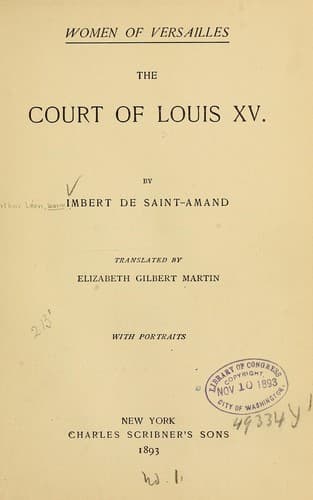
France -- Court and courtiers; France -- History -- Louis XV, 1715-1774
Former series of M. Imbert de Saint-Amand’s historical works have
depicted the great French historical epochs of modern times. The
stirring events of the Revolution, of the Consulate and Empire, and of
the Restoration period, ending with the July revolution of 1830 and
the accession of Louis Philippe, are grouped around the attractive
personalities of Marie Antoinette, the Empresses Josephine and Marie
Louise, and the Duchesses of Angoulême and of Berry. The remarkable
and uniform success of these works has induced the publishers to
undertake the translation and publication of a previous series of
M. de Saint-Amand’s volumes which deal with epochs more remote, but
not for that reason less important, interesting, or instructive. The
distinction of the cycle now begun with the “Women of the Valois
Court” and ending with “The Last Years of Louis XV.,” is that, whereas
in former series several volumes have been devoted to the historical
events associated with each of the titular personalities to which
they were closely related, in the present instance a more condensed
method is followed. The color of the present series is more personal,
and therefore more romantic, as is to be expected in the annals of
a period during which the famous women of the French Court were not
only more numerous but more influential than their successors of later
times. The dawn of the modern era, chronicled in M. de Saint-Amand’s
“Marie Antoinette and the End of the Old Régime” was the beginning of
the extinction of the feminine influence that flourished vigorously in
affairs of state from Marguerite of Angoulême to Madame Dubarry. It is
the history of this influence that the author has graphically written
in the four volumes now announced--“Women of the Valois Court,” “The
Court of Louis XIV.,” and “The Court of Louis XV.,” and “The Last Years
of Louis XV.”
The first volume is devoted to Marguerite of Angoulême and Catherine
de’ Medici and their contemporaries at the French court during the
days of the last of the Valois--the most romantic period of royalty
probably in all history. The two principal figures are depicted with
striking vividness,--the half Catholic, half Protestant sister of
Francis I., the grandmother of Henry IV., the author of the famous
“Heptameron,” and one of the most admirable historical figures of any
epoch; and the diplomatic, ambitious, unscrupulous but extremely human
Catherine, universally held responsible for the awful Massacre of Saint
Bartholomew. But the subordinate though scarcely less famous women who
adorned the Valois Court--Diane de Poitiers, the Duchess d’Étampes,
Marguerite of Valois, Marie Stuart, and others--are described with an
equally brilliant and illuminating touch.
Public-domain text, read in full here on John Shaqi.
Reviews
Reviews
No reviews yet
Be the first to share your thoughts on this work.
Elsewhere in the archive
Join the Discussion
Join the discussion
Sign in to leave a comment or review.
Sign InorCreate an account