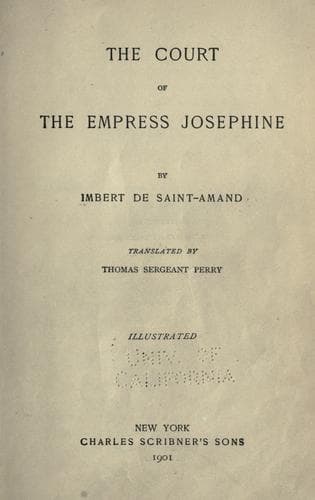
The Court of the Empress JosephineImbert de Saint-Amand
History
The Court of the Empress Josephine
Imbert de Saint-Amand
Josephine, Empress, consort of Napoleon I, Emperor of the French, 1763-1814
The Emperor, in dividing the flags which he had captured from Russia and
Austria, had given fifty-four to the Senate, eight to the Tribunes, eight
to the city of Paris, and fifty to the church of Notre Dame, which he
wished to adorn with his trophies as the Marshal of Luxembourg had done in
the reign of Louis XIV. The day when these fifty flags were given to the
Cathedral the Cardinal Archbishop of France said, "O Posterity, when you
read our history you will imagine that you are reading anew the fall of
the walls of Jericho, and listening to the miraculous deeds of Joshua,
David, and Judas Maccabaeus. _Benedictus Dominus qui facit mirabilia
solus_.... God of Marengo, you declare yourself the God of Austerlitz; and
the German eagle, the Russian eagle, abandoned by you, became the prey of
the French eagle, which you never cease to protect." A singular piece of
flattery this, to call the Creator of the universe--of which this earth is
not a millionth part--the God of a village, because near this village a
man has wrought the death of many other men!
Paris seemed to have recovered its ardor of the first days of the
Revolution in order to salute the triumphant hero. The day of his arrival,
January 27, 1806, the managers of the bank, anxious that his presence
should be the signal for public prosperity, ordered the resumption of
specie payments. The Opera celebrated his return and that of the Empress
by a grand performance which took place February 4. The bills announced
the _Pretendus_ and a divertisement, The public knew that this
divertisement was to be a sort of apotheosis in honor of the Imperial
glories. The house was crowded, and the passages themselves were crammed
by the enthusiastic crowd. During the second act of the _Pretendus_ there
was great excitement over the arrival of Napoleon and Josephine. Applause
resounded from every side. Ladies distributed laurel branches, which all
the spectators waved, shouting, "Long live the Emperor!" Musicians played
the chorus of the _Caravan_. Meanwhile, the scenery of the _Pretendus_
disappeared, and applause began over the magnificent decorations that took
its place. It was a semicircular enclosure with trophies forming a
colonnade showing the course of the Seine from the Pont Neuf to the
western limit of Paris, showing the Louvre, which Napoleon had promised to
complete, the Pont des Arts, the Palais de la Monnaie, the Tuileries, and
in the misty distance the Champs Elysees overlooking this fine view. The
interior of the enclosure was adorned with garlands and crowded with
people, awaiting the return of the Grand Army. This appeared with a
military march: the sappers in front with their axes and white aprons; the
grenadiers of the Guard with their high fur caps; the artillerymen with
their black caps; the dragoons with their double armor; the Mamelukes with
their scimetars. Then came the Bavarians, worthy comrades of Napoleon's
soldiers. The people applauded their defenders. Pupils of the military
Public-domain text, read in full here on John Shaqi.
Reviews
Reviews
No reviews yet
Be the first to share your thoughts on this work.
Elsewhere in the archive
Join the Discussion
Join the discussion
Sign in to leave a comment or review.
Sign InorCreate an account