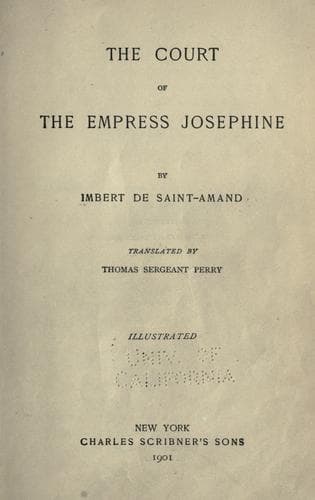
The Court of the Empress JosephineImbert de Saint-Amand
History
The Court of the Empress Josephine
Imbert de Saint-Amand
Josephine, Empress, consort of Napoleon I, Emperor of the French, 1763-1814
The marriage was celebrated with great pomp in the chapel of the Palace of
the Tuileries, April 8, 1806, at eight in the evening. The witnesses for
the bridegroom were the Crown Prince of Bavaria, Baron de Gueusau, and M.
de Dalberg; those of the bride were M. de Talleyrand, M. de Champagny, and
M. de Segur. The procession went from the grand apartments to the chapel
in the following order: the Empress, preceded by the officers of the
Princesses, accompanied by the Prince of Baden, the Princesses, and the
Crown Prince of Bavaria, and followed by the ladies of her household and
of those of the Princesses; the Emperor, conducting the bride, and
preceded by the officers of the Princes, his own officers, the Grand
Dignitaries of the Empire, the Ministers, the High Officers of the Crown,
and followed by the colonel-general of the guard on duty. At the chapel
door the clergy received Napoleon and Josephine beneath a canopy, and they
took their places on two small thrones in front of the altar, while the
Prince of Baden and the bride took their places on two stools at the foot
of its steps. The ceremony began with the blessing of thirteen pieces of
gold which the Cardinal Caprara, Legate _a latere_, gave to the Prince of
Baden, who presented them to his bride. The Cardinal gave them the nuptial
blessing. Meanwhile Monsignor Charier-Lavoche, Bishop of Versailles, the
Emperor's First Almoner, and Monsignor de Broglie, Bishop of Acqui, his
Almoner in Ordinary, were holding a canopy of silver brocade over the head
of the kneeling Prince and Princess. These two prelates wore a camail and
rochet. Cardinal Caprara and his assistant, Monsignor de Rohan, the
Empress's Almoner, wore the golden cape.
During the ceremony, which lasted about an hour, the front of the
Tuileries and the garden were illuminated. At nine o'clock there were
fireworks on the Place de la Concorde, which the Emperor and Empress
watched from the balcony of the Hall of the Marshals. As they appeared on
the balcony with the young people, they were greeted with warm applause
from the dense crowd in the garden. The Empress, who was clad in a dress
embroidered with gold, wore on her head, besides the Imperial crown, a
million francs' worth of pearls. Princess Stephanie was charming in her
white tulle dress, with silver stars, trimmed with orange flowers, and her
diamond frontlet. After the fireworks came a concert and ballet in the
Hall of the Marshals. But little attention was paid to the concert,
although silence prevailed; the ballet, which was rendered by the best
dancers from the Opera, was very successful. Then the company went to the
Gallery of Diana, where tables had been set for two hundred ladies, and a
magnificent supper was served. The grace and distinction of the bride
aroused general admiration. Her father, Senator Beauharnais, kept silence
and wept for joy.
Public-domain text, read in full here on John Shaqi.
Reviews
Reviews
No reviews yet
Be the first to share your thoughts on this work.
Elsewhere in the archive
Join the Discussion
Join the discussion
Sign in to leave a comment or review.
Sign InorCreate an account