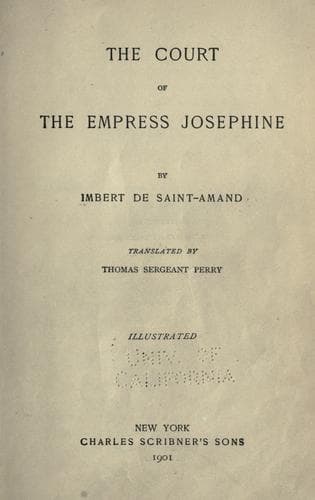
The Court of the Empress JosephineImbert de Saint-Amand
History
The Court of the Empress Josephine
Imbert de Saint-Amand
Josephine, Empress, consort of Napoleon I, Emperor of the French, 1763-1814
This is the second letter, dated December 3, 6 P.M.: "I have your letter
of November 27, and I see that your little head is much excited. I
remember the line: 'A woman's wish is a devouring flame,' and I must calm
you. I wrote to you that I was in Poland, that when we should have got
into winter-quarters you might come; so you must wait a few days. The
greater one becomes, the less will one must have; one depends on events
and circumstances. You may go to Frankfort or Darmstadt, I hope to summon
you in a few days, but events must decide. The warmth of your letter
convinces me that you pretty women take no account of obstacles; what you
want must be; but I must say that I am the greatest slave that lives; my
master has no heart, and this master is the nature of things." Napoleon
should have said: Providence. Man proposes, but God disposes.
Napoleon again spoke a little of having Josephine come. He wrote to her
December 10: "An officer has brought me a rug from you; it is a little
short and narrow, but I am no less grateful to you for it. I am fairly
well. The weather is very changeable. Everything is in good condition. I
love you and am very anxious to see you. Good by, my dear: I shall write
to you to come with more pleasure than you will come."
December 12 he spoke once more of this projected journey which became ever
more and more remote, like a mirage in the desert: "My health is good, the
weather very mild; the bad season has not begun, but the roads are bad in
a country where there are no highways. So Hortense will come with
Napoleon; I am delighted. I am impatient to have things settle themselves
so that you can come. I have made peace with Saxony. The Elector is King
and belongs to the confederation. Good by, my dearest Josephine. Yours
ever. A kiss to Hortense, to Napoleon, and to Stephanie. Paer, the famous
musician, his wife, whom you saw at Milan twelve years ago, and Brizzi,
are here; they give me some music every evening." Napoleon left Posen in
the middle of December. The evening before his departure he wrote a letter
to his wife which showed the unlikelihood of her joining him, as she hoped
to do; "I am leaving for Warsaw, and shall be back in a fortnight. I hope
then to have you here. Still, if that is too long I should be glad to have
you return to Paris where you are needed. You know that I have to depend
on events." The unhappy Josephine already had a foreboding of his devotion
to a great Polish lady.
Public-domain text, read in full here on John Shaqi.
Reviews
Reviews
No reviews yet
Be the first to share your thoughts on this work.
Elsewhere in the archive
Join the Discussion
Join the discussion
Sign in to leave a comment or review.
Sign InorCreate an account