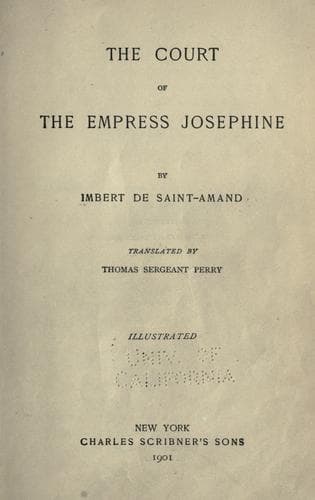
The Court of the Empress JosephineImbert de Saint-Amand
History
The Court of the Empress Josephine
Imbert de Saint-Amand
Josephine, Empress, consort of Napoleon I, Emperor of the French, 1763-1814
In spite of these official flatteries, and more or less interested
compliments, the Empress was far from happy. Possibly she imagined that
soon, even in her lifetime, the same homage would be addressed by the same
persons, in the same palace, to another woman. Besides this, however, she
had many causes for distress. She suffered from the absence of her
children, from her daughter's domestic unhappiness, from the Emperor's
remoteness, his infidelities in Poland, from the dangers threatening him
in this relentless and distant war. She wrote to her daughter February 3:
"I got here, dear Hortense, the evening of the 31st, as I expected. My
journey was pleasant, if I can call it so when it separated me further
from the Emperor. I have received five letters from him since my
departure. I need to hear from you now that you are no longer with me to
console me. Tell me how you are; write to me about your husband and
children. Although I see more people here than at Mayence, I am quite as
lonely, and you will seem to be with me if you write. Good by, my dear, I
love you tenderly." Josephine yearned all the more eagerly for happiness
as a mother, because as wife she suffered cruelly, and the torments of
jealousy were added to her grief at the Emperor's absence.
To one of the last letters his wife had written from Mayence Napoleon
answered in an undated letter which she received in Paris: "My dear, your
letter of January 20, has pained me much; it is too sad. That is the
result of excessive piety! You tell me that your happiness makes your
glory. That is ungenerous; you ought to say, the happiness of others makes
my glory. It is not like a mother; you ought to say, the happiness of my
children is my glory. It is not like a wife; you ought to say, my
husband's happiness makes my glory. Now, since the nation, your husband,
your children cannot be happy without a little glory, you should not
despise it. Josephine, you have a good heart, but a weak head; your
feelings are most admirable; you reason less well. But that is enough
squabbling; I want you to be merry, content with your lot, and to obey,
not grumbling and crying, but cheerfully and happily. Good by, my dear.
I'm off to-night, to inspect my outposts." It must be confessed that to be
as merry as the Emperor demanded, Josephine would have needed a very
exceptional character. Her husband was at the other end of Europe, never
interrupting the intense emotions and great risks of a colossal struggle
except for brief distractions, which, however, could not be agreeable, so
suspicious and jealous as she was.
Public-domain text, read in full here on John Shaqi.
Reviews
Reviews
No reviews yet
Be the first to share your thoughts on this work.
Elsewhere in the archive
Join the Discussion
Join the discussion
Sign in to leave a comment or review.
Sign InorCreate an account