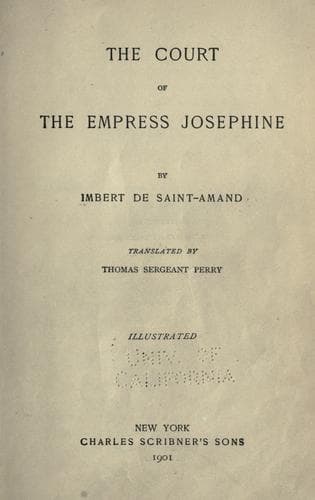
The Court of the Empress JosephineImbert de Saint-Amand
History
The Court of the Empress Josephine
Imbert de Saint-Amand
Josephine, Empress, consort of Napoleon I, Emperor of the French, 1763-1814
Towards the end of February Napoleon had established his headquarters at
Osterode, where he lived in a sort of barn, from which he governed his
Empire and controlled Europe. He wrote to his brother Joseph, March 1,
about the sufferings of this severe campaign in Poland. "The staff-
officers have not taken off their clothes for two months, and some not for
four, I have myself been a fortnight without taking off my boots.... We
are deep in the snow and mud, without wine, brandy, or bread, living on
meat and potatoes, making long marches and counter-marches, without any
comforts, and generally fighting with the bayonets under grape-shot; the
wounded have to be carried in open sleighs for fifty leagues.... We are
making war in all its excitement and horror." It is easy to see that
Josephine, who knew all this, had good grounds for anxiety. Paris was
empty and gloomy; every face was sad. France is easily tired of
everything, even of glory. The auditors of the Council of State, who were
sent to Osterode to carry to the Emperor the reports of the different
ministers, returned to Paris in deep distress at the sights they had seen,
and spread alarm in official circles. Napoleon consequently decided that
those reports should be brought to him by staff-officers, who were more
inured to scenes of distress.
From headquarters at Osterode the Emperor sent eleven letters to the
Empress between February 23 and April 1, 1807, but he said nothing of
importance in them. Thus: "Try to pass your time agreeably; don't be
anxious. I am in a wretched village where I shall be some time; it's not
so pleasant as a large city. I tell you again, I have never been so well;
you will find me much stouter.... I have ordered what you want for
Malmaison; be happy and cheerful; that's what I desire. I am waiting for
good weather, which must come soon. I love you, and want to hear that you
are contented and cheerful. You will hear a good deal of nonsense about
the battle of Eylau; the bulletin tells everything; its report of the
losses is rather exaggerated than cut down." At the same time he somewhat
reproved his wife: "I am sorry to hear that there is a renewal of the
mischievous talk such as there was in your drawing-room at Mayence; put a
stop to it. I shall be much annoyed if you don't find some clue. You let
yourself be distressed by the talk of people who ought to cheer you up. I
recommend to you a little firmness, and to learn how to put everybody in
his place. My dear, you must not go to the small theatres in private
boxes; it does not suit your rank; you ought to go only to the four large
theatres and always sit in the Imperial box. If you want to please me, you
must live as you did when I was in Paris. Then you did not go to the small
theatres or such places. You ought always to go to the Imperial box. For
your life at home, you must have regular receptions; that is the only way
of winning my approval. Greatness has its inconveniences. An Empress can't
Public-domain text, read in full here on John Shaqi.
Reviews
Reviews
No reviews yet
Be the first to share your thoughts on this work.
Elsewhere in the archive
Join the Discussion
Join the discussion
Sign in to leave a comment or review.
Sign InorCreate an account