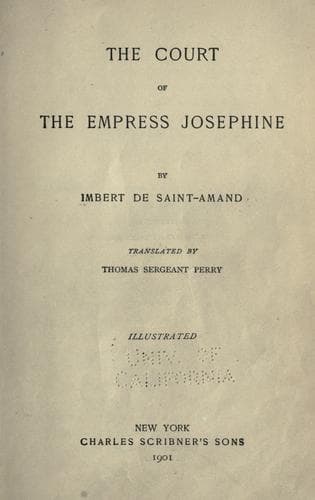
The Court of the Empress JosephineImbert de Saint-Amand
History
The Court of the Empress Josephine
Imbert de Saint-Amand
Josephine, Empress, consort of Napoleon I, Emperor of the French, 1763-1814
The little Prince had a sudden attack of croup in the night of May 4,
1807. He was thought to be lost, but in the evening he was a little
better, and the physicians had some hope of saving him. The improvement
lasted but a few minutes. In the course of the day he was given some
English powders, which lent him a feverish strength, so that at six in the
evening he asked for some cards and pictures to play with, but the fever
only gave way to his death agony. Towards ten in the evening the child
drew his last breath.
No words can describe the unhappy Queen's despair; she became stony with
grief, and fears were felt for her reason. Josephine's grief was
boundless. She did not dare to leave the Empire without the Emperor's
authorization, and so did not go to The Hague, but went in all haste to
the Castle of Laeken, near Brussels, whence she wrote to Hortense in the
evening of May 14: "I have just readied the Castle of Laeken, my dear
daughter, and await you here. Come and give me life; your presence is
necessary for me, and you must have need of seeing me and of weeping with
your mother. I should have liked to go further, but I was too weak, and
besides I had not time to send word to the Emperor. I have summoned
courage to come thus far; I hope that you will have enough to come to your
mother. Good by, my dear daughter, I am worn out with fatigue and
especially with grief." In the evening of May 15, Hortense arrived at the
Castle of Laeken, accompanied by her husband and her sole surviving son.
She was motionless, apathetic, the figure of despair. M. de Remusat, who
was with the Empress, wrote the next day to his wife: "The Queen has but
one thought, the loss she has suffered; she speaks of only one thing, of
_him_. Not a tear, but a cold calm, an almost absolute silence about
everything, and when she speaks she wrings every one's heart. If she sees
any one whom she has ever seen with her son, she looks at him with
kindliness and interest, and says, 'You know he is dead.' When she first
saw her mother, she said to her: 'It's not long since he was here with me.
I held him on my knees thus.' Seeing me a few minutes later, she made a
sign for me to come forward. 'Do you remember Mayence? He acted with us.'
She heard ten o'clock strike; she turned to one of the ladies and said,
'You know it was at ten that he died.' That is the only way she breaks her
almost continual silence. With all that, she is kind, sensible, perfectly
reasonable; she thoroughly understands her condition, and even speaks of
it. She says she is glad that she has fallen into this numb state,
otherwise her sufferings would have been too intense. Some one asked her
if she was much moved when she saw her mother: 'No,' she answered; 'but I
am very glad to have seen her.' Mention was made of Josephine's surprise
at her lack of emotion on seeing her; 'Oh, Heavens!' she said, 'she must
not mind it; that's the way I am.' To anything that is asked her on any
Public-domain text, read in full here on John Shaqi.
Reviews
Reviews
No reviews yet
Be the first to share your thoughts on this work.
Elsewhere in the archive
Join the Discussion
Join the discussion
Sign in to leave a comment or review.
Sign InorCreate an account