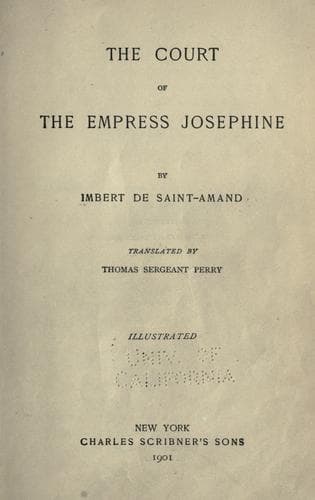
The Court of the Empress JosephineImbert de Saint-Amand
History
The Court of the Empress Josephine
Imbert de Saint-Amand
Josephine, Empress, consort of Napoleon I, Emperor of the French, 1763-1814
Josephine appeared to have every wish, satisfied; her good fortune
exceeded her wildest dreams; never had a more wonderful romance actually
happened, and yet the Empress of the French, the Queen of Italy, was not
happy. A cruel passion which brings no pleasures, but only cruel
sufferings, disturbed her happiness and tormented her heart. This passion,
jealousy, which had tortured Napoleon in the early days of his wedded
life, now Josephine in her turn had to endure with all its keen anguish.
She felt that for her, a woman of forty-one, to hold fast the affections
of a man of thirty-five, covered with glory and full of charm, was a
difficult task; but this reflection, far from consoling her, only
disturbed her the more, and she made desperate efforts to triumph in an
almost hopeless contest. As was said by Mademoiselle Avrillon, her reader,
she seemed not to understand that if the highest rank is a safeguard for a
woman, because few men are bold enough to pursue her, the same is not true
of a sovereign whose glory dazzles the inexperience of the young, and
whose slightest attention arouses coquetry and flatters vanity.
Josephine had not a moment's peace. In the hope of pleasing her, many
women of the court, who were, so to speak, on the watch for the Emperor's
attentions, hastened to torture her with their interested revelations. For
several years now her beauty had been fading. Napoleon, on the other hand,
had never been better looking. His health, which formerly had been
delicate, had much improved. He had grown stouter, and this was very
becoming. His head was like that of a Caesar. Full of self-confidence,
fortunate, flattered on every side, at the height of power, he imagined
that in love, as in war, he had but to appear to say, _veni, vidi, vici_,
"I came, I saw, I conquered." Many of the beauties of the time did their
best to confirm him in this good opinion of himself, and as Madame de
Remusat says of him, he in his court was not unlike the Grand Turk in his
harem.
"The Emperor," we read in Constant's Memoirs, "used to say that a good man
was to be known by the way he treated his wife, his children, and his
servants. He added that immorality was the most dangerous vice a sovereign
could have, because it established a precedent for his subjects. What he
meant by immorality, was giving scandalous publicity to relations which
should have been kept secret; these relations he was by no means disposed
to refuse when they presented themselves before him." The faithful valet
de chambre goes on in an attempt to defend his master: "Others perhaps
would have succumbed oftener. Heaven forbid that I should undertake to
apologize for him; I will even acknowledge that he did not always practise
what he preached, but it was none the less a good deal for a sovereign to
hide his distractions from the public, to prevent scandal, and, what is
worse imitation; and from his wife, to save her pain."
Public-domain text, read in full here on John Shaqi.
Reviews
Reviews
No reviews yet
Be the first to share your thoughts on this work.
Elsewhere in the archive
Join the Discussion
Join the discussion
Sign in to leave a comment or review.
Sign InorCreate an account