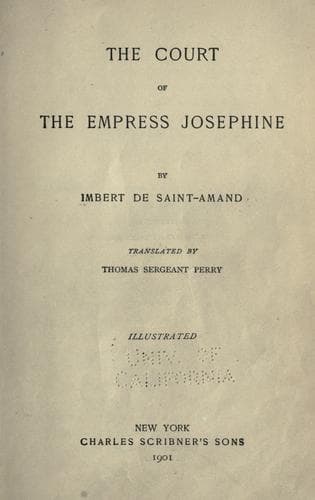
The Court of the Empress JosephineImbert de Saint-Amand
History
The Court of the Empress Josephine
Imbert de Saint-Amand
Josephine, Empress, consort of Napoleon I, Emperor of the French, 1763-1814
Napoleon was by no means so indifferent to women as he professed to be. He
was averse to being ruled by them, but he was far from being insensible to
their charms. Opposition exasperated him; all his caprices found many
obsequious allies ready to further his suit, and more than one woman made
a deep, if brief, impression upon him. His disdain of woman has, we are
sure, been much exaggerated. At Saint Helena he declaimed against women,
but his remarks were mere paradoxes, not meant to be taken seriously.
Count Las Cases, in the _Memorial_, reports these remarks of the Emperor
to the ladies who shared, his captivity. "We Occidentals," he said, with a
smile full of malice, "have spoiled women by treating them too well. We
have made the mistake of raising them almost to an equality with
ourselves. The Orientals showed more intelligence and justice: they
declared they were men's property; and, in fact, nature has made them our
slaves, and it is only by our whimsicalness that they presume to be our
sovereigns; they abuse their advantages to mislead and control us. For one
who inspires us to our good there are a hundred who make us do stupid
things." Then he went on to praise polygamy in a very unchivalrous and
unsentimental way, saying ironically: "What cause of complaint do you
have, after all? Have we not acknowledged that you have a soul? You know
that there are philosophers who have weighed it. Do you claim equality?
But that is absurd; women are our property, we are not theirs; for she
gives us children, men give them none. So she is his property, as a fruit-
tree is a gardener's property. Nothing but a lack of judgment, of common
sense, and a defective education, can make a woman think that she is her
husband's equal. And there is nothing degrading in the difference; each
sex has its qualities and its duties: your qualities are beauty, grace,
charm; your duties are dependence and submission."
Napoleon was often malicious with women; often he teased them; but at
heart he honored faithful wives and good mothers. His ideas were far more
moral than those of the men of the Directory, and his court was far purer
than that of the kings of France. We will add that Josephine was the only
woman he ever loved for a long time and seriously. The others appealed to
his senses, not to his heart.
Public-domain text, read in full here on John Shaqi.
Reviews
Reviews
No reviews yet
Be the first to share your thoughts on this work.
Elsewhere in the archive
Join the Discussion
Join the discussion
Sign in to leave a comment or review.
Sign InorCreate an account