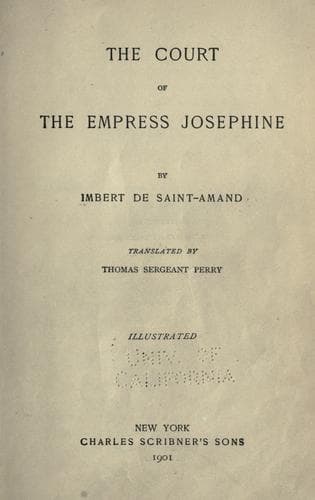
The Court of the Empress JosephineImbert de Saint-Amand
History
The Court of the Empress Josephine
Imbert de Saint-Amand
Josephine, Empress, consort of Napoleon I, Emperor of the French, 1763-1814
It has been asserted that the Pope made such an impression in Paris that
the Emperor felt for the august old man a sort of secret jealousy. But
even granting, what is by no means certain, that he suffered from this, he
had at least skill to conceal it. Always the Pope was overwhelmed with
flattering attentions. The President of the Legislative Body, M. de
Fontanes, said to him November 30, 1804: "Everything else has changed;
religion alone knows no change. It sees the families of kings, and those
of subjects, perish; but resting on the ruins of thrones, it ever admires
the successive manifestations of the eternal designs and obeys them with
confidence. Never has the universe beheld a more imposing sight, never
have its people received more important lessons. This is no longer the
time of rivalry between the priesthood and the Empire. They have joined
hands to repel the fatal doctrines which threatened Europe with total
overthrow. May they yield forever to the double influence of politics and
religion combined! Doubtless this wish will not be disappointed; never in
France has there been so great a genius to control its policy, and never
has the pontifical throne presented to the Christian world a more worthy
and more touching model." The _Moniteur_, in its report of the coronation,
spoke with the same official enthusiasm "of the most venerable apostolic
virtues and of the most astounding political genius crowned by the highest
destinies." David, the artist, once a member of the Convention and a
regicide, then an Imperialist, painted the portrait of Pius VII., and the
_Moniteur_ in the number of March 30, 1805, thus praised the picture and
the sitter. "A large crowd gathered in the gallery of the Senate, to see
the portrait of His Holiness by M. David, member of the Institute and
first painter to the Emperor. This portrait is in every way worthy of the
master's reputation. If the first essential in a portrait is an exact
likeness, this one possesses it to a very high degree. The head, which is
admirably painted, expresses the indulgent and wise character, the
gentleness and reasonableness, that are so conspicuous in the model; the
eyes an expression, affectionate and paternal; the expression of the mouth
is most striking; one feels that it can utter only words of peace,
consolation, and truth."
Josephine had for Pius VII. a feeling of veneration full of gratitude. She
was most grateful to him for having persuaded Napoleon, to have the
religious marriage for which she had long yearned. She, who had preserved
her faith, in the midst of an irreligious society, was happy to inhabit
the same palace, to live under the same roof, with the Vicar of Christ,
and firmly hoped thereby to secure good fortune for herself and her
husband. For his part, Pius VII. appreciated Josephine's good qualities,
especially her charity: he treated her as an indulgent father treats his
child.
Public-domain text, read in full here on John Shaqi.
Reviews
Reviews
No reviews yet
Be the first to share your thoughts on this work.
Elsewhere in the archive
Join the Discussion
Join the discussion
Sign in to leave a comment or review.
Sign InorCreate an account