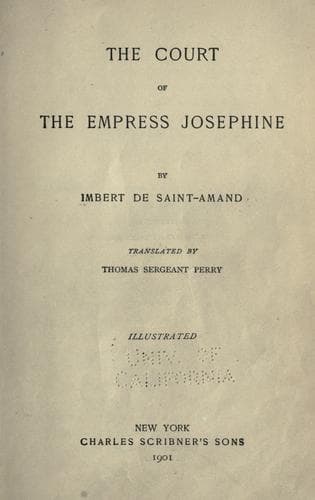
The Court of the Empress JosephineImbert de Saint-Amand
History
The Court of the Empress Josephine
Imbert de Saint-Amand
Josephine, Empress, consort of Napoleon I, Emperor of the French, 1763-1814
The next day games were celebrated, in the manner of the ancients, in a
circus rivalling the Roman amphitheatres in size. This was the occasion of
a dithyrambic outburst inserted in the _Moniteur_: "The Italians have just
offered Napoleon the same spectacle that their ancestors offered Marcus
Aurelius and Trajan; but the presence of Napoleon has called forth more
joy and admiration, because it has aroused greater admiration and higher
hopes. They were but the preservers of Italian greatness; he is its
creator and its father. In the pomp of the games, amid the tumultuous
applause, the immense mass of people were to be seen turning their eyes
towards him alone, as if they were saying to him: 'These festivities are
but feeble expressions of the gratitude that all Italy vows to you for all
the good you have done her; and since you deign to accept it, since you
like to sit among us as our Prince and our father, these festivities
become an augury to us of still greater benefit. The day will perhaps come
when Italy, restored to this new life, may be able to adorn its circus
with the monuments of its own bravery which will also be the monuments of
your glory; and Italy, being never doomed to perish, whatever great deeds
may be wrought by Italians in the course of centuries will be due to the
hero who has recalled them to life.'" After the races there was a balloon
ascension. The courageous wife of the aeronaut Garnerin accompanied him
and threw down flowers to Napoleon and Josephine. "Thus," the _Moniteur_
goes on, "in a single day, at one show, the Italians have combined the
proudest pomp of the ancients and the boldest invention of modern science,
together with the presence of a hero who excels both ancients and
moderns."
The 29th of May was devoted to popular festivities. All the afternoon the
public gardens were crowded with musicians, singers, mountebanks, and
pedlars. In the evening the via della Riconoscenza, as far as the East
Gate, was lit by lampstands, and at the end of a long row there was an
eagle of fire holding on his breast an iron crown.
Nothing was neglected to touch the national pride of Italy. An article in
the _Moniteur_, speaking of a poem of Vincenzo Monti's, said: "What
interest the poet has aroused, in recalling the glorious titles of ancient
Italy, the disasters and degradation which followed this period of glory,
in evoking the shades of those remote days, and after them, the shade of
Dante who, by the wisdom of his maxims, is superior to the poets of other
nations; of Dante, the most enthusiastic admirer of the former glory of
the Italians, the severest censor of the corruption into which Italy had
fallen in his time; of Dante, whose sole ambition was to prepare the new
birth of Italy! And how did he prepare it? By preaching union to the
inhabitants of the different countries of Italy, and to the public
authorities the consecration of power modified by the laws."
Public-domain text, read in full here on John Shaqi.
Reviews
Reviews
No reviews yet
Be the first to share your thoughts on this work.
Elsewhere in the archive
Join the Discussion
Join the discussion
Sign in to leave a comment or review.
Sign InorCreate an account