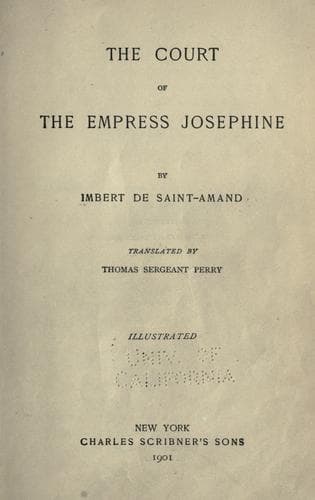
The Court of the Empress JosephineImbert de Saint-Amand
History
The Court of the Empress Josephine
Imbert de Saint-Amand
Josephine, Empress, consort of Napoleon I, Emperor of the French, 1763-1814
June 7 Napoleon appointed Eugene de Beauharnais Viceroy of the Kingdom of
Italy, and three days later left Milan with Josephine. In all the
principal cities of the Empire his coronation had been celebrated by
public rejoicings. Murat had given a ball at his castle of Neuilly, about
which the _Journal des Debats_ had said: "At the same moment when the arts
of ingenious Italy were displaying all their marvels under the eyes of
Their Majesties, French gallantry and gaiety were rendering similar homage
to the happy reign which had recalled them from a long exile."
Aix-la-Chapelle inaugurated the statue of the great Carlovingian Emperor
amid salvos of artillery and the applause of the Germanic populace, who
saluted at the same time the names of Charlemagne and of Napoleon.
XIV.
THE FESTIVITIES AT GENOA.
The Italian journey closed as brilliantly as it began. After leaving
Milan, Napoleon approached the frontiers of Austria, against which he was
to fight before the end of the year, visiting the celebrated
quadrilateral, consisting of the four fortified towns: Mantua, Peschiera,
Verona, and Legnago. He was present at a mimic representation of the
battle of Castiglione, in which twenty-five thousand men took part on the
field upon which that battle had been fought; then he went to Bologna,
where the charms of his conversation were highly appreciated by the
learned professors of its university. While he was there a deputation from
Lucca visited him, asking him to take that little country under his
protection. He gave it for Prince and Princess, his brother-in-law, Felix
Bacciocchi, and his sister Elisa, to whom he had already entrusted the
Duchy of Piombino. Lucca was thus elevated to a hereditary principality, a
dependent of the French Empire, which should revert to the French crown in
case the male line of the Bacciocchi should become extinct. It was a sort
of revival of the old Germanic fiefs. Evidently the memory of Charlemagne
continually filled Napoleon's thoughts. Elisa thenceforth bore the title
of Princess of Lucca and of Piombino. She was a well educated and able
woman, of marked intelligence and strong will. M. de Talleyrand used to
call her "the Semiramis of Lucca." After Bologna, Napoleon visited Modena,
Parma, and Piacenza. The cities he passed through rivalled one another in
flattery. They voted him medals, statues, and even a temple, which,
however, the demi-god declined.
Public-domain text, read in full here on John Shaqi.
Reviews
Reviews
No reviews yet
Be the first to share your thoughts on this work.
Elsewhere in the archive
Join the Discussion
Join the discussion
Sign in to leave a comment or review.
Sign InorCreate an account