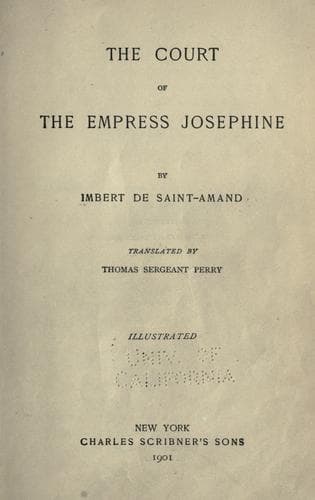
The Court of the Empress JosephineImbert de Saint-Amand
History
The Court of the Empress Josephine
Imbert de Saint-Amand
Josephine, Empress, consort of Napoleon I, Emperor of the French, 1763-1814
Alas! thoughtful people should never forget how much greater is virtue
than success. In this low world no one takes a lofty enough view of
things. Not after defeat, but after victory, is the time to speak of war
seriously and sadly. If Napoleon in the hour of triumph had not been
flattered to excess, if at the proper moment the lessons of history,
philosophy, and religion had been enforced upon him, he would not have
rushed blindly into the gulf that finally swallowed him. Nothing is less
humane, less Christian, than the extravagant praise lavished on the
conquerors of the earth. Laymen and priests are equally to blame, for the
flatterers of conquerors bear perhaps a heavier responsibility than the
conquerors themselves. In the ancient triumphs, at least there was a slave
charged with reminding the hero that he was but a man; in modern times,
there is nothing of the sort; the hero can imagine himself more than
mortal. Why does not the clergy, instead of intoning a _Te Deum_, take the
part of that slave? Is it well to forget that those nations who are most
modest in success are bravest and most resigned in misfortune? Those whose
heads are turned by prosperity cannot endure reverses. For society, as for
individuals, nothing is more baneful than outbursts of joy and pride. The
vaster a monarch's power, the greater his need to meditate on the
fickleness of fate; but the lessons of wisdom are never recalled till they
are useless; they are whispered into his ears only when they can but add a
sting to defeat.
XVI.
THE MARRIAGE OF PRINCE EUGENE.
Both before and after the battle of Austerlitz a great part of Germany was
at Napoleon's feet. The Electors of Baden, Wuertemberg, and Bavaria the
last two of whom were to become kings by the consent of the new
Charlemagne, testified an enthusiastic admiration for him, and were all to
profit by his victory. The petty princes who were about to enter the
Confederation of the Rhine were his humble vassals, and paid obsequious
court to his Minister of Foreign Affairs, M. de Talleyrand. The archives
of our Ministry of Foreign Affairs would have to be consulted for an exact
understanding of their servility and flattery. Moreover, the populace
itself shared the feelings of their princes. The Bavarians regarded
Napoleon as their liberator. French manners and ideas were more than ever
prevalent on the banks of the Rhine, and Germanic patriotism pardoned
France the possession of the left bank of this river. If Napoleon had not
abused fortune, what grand and pacific things might he not have
accomplished in concert with Germany, and what progress might not have
been made for the harmony of nations, for civilization and humanity!
Public-domain text, read in full here on John Shaqi.
Reviews
Reviews
No reviews yet
Be the first to share your thoughts on this work.
Elsewhere in the archive
Join the Discussion
Join the discussion
Sign in to leave a comment or review.
Sign InorCreate an account