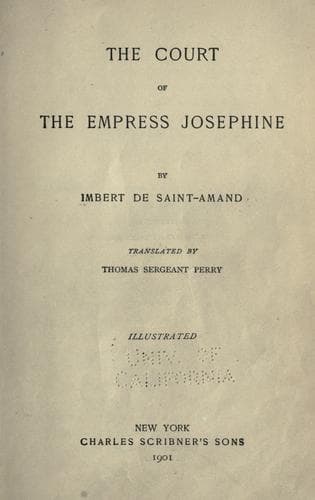
The Court of the Empress JosephineImbert de Saint-Amand
History
The Court of the Empress Josephine
Imbert de Saint-Amand
Josephine, Empress, consort of Napoleon I, Emperor of the French, 1763-1814
November 28, at six in the evening, the Empress formally entered
Carlsruhe, which was amid a general illumination. At the Muehburger gate
stood an arch of triumph under which she passed. In front of the arch was
this inscription: _Pro Imperatrice Josephina_; on the other, _Votiva
lumina ardent_. At the entrance of the castle gate stood a little temple
bearing this inscription: _Salve_. In the middle of the garden was a
larger temple, in which was to be seen on a pedestal the Emperor's bust,
crowned with laurels and surrounded with palms. The inscription ran:
_Maximis triumphis sacrum_,--"Consecrated to the greatest triumphs." On
two pyramids was to be read this motto: "Love leads to glory." November
29, there was a grand reception and concert in her honor at the court, At
nine o'clock in the morning of the 30th, she left Carlsruhe for Stuttgart,
after an affectionate farewell to the Electoral family.
At seven that evening she made a similar formal entrance into the capital
of Wuertemberg, passing under an arch of triumph bearing her name
surmounted by an Imperial crown. Soldiers lined the way from the gate to
the Elector's castle. The main street was decorated with Egyptian altars,
and was brilliantly illuminated, as was the castle also. The Elector, his
wife, a daughter of the King of England, and all the court received the
Empress at the castle door and escorted her to her rooms, where she
supped. The next day she sat on a platform at a state dinner in the white
hall. Afterwards the company went to the Opera House, where _Achilles_ was
given. After they had returned to the castle there were some fine
fireworks. These festivities continued until December 2, when _Romeo and
Juliet_ was given for the first time, and the 3d, at seven in the morning,
Josephine, after bidding the family farewell, pushed on towards Munich,
while the troops presented arms and cannon were fired.
The Empress was not to stop between Stuttgart and Munich, but on her way
she saw many places that had just become famous in the war. As she drew
near them she looked at the plain where, a few days before, the enemy's
army had marched out before Napoleon and laid down its arms. From Augsburg
to Munich, everything made her journey most brilliant; arches of triumph,
bands of music so numerous that often their notes mingled with one
another, wreaths of leaves, successive guards of honor who joined her,
composed of the Royal Guard of Italy, at nearly every parting station. As
a letter in the _Moniteur_ says, "Enthusiasm succeeded to fear, the whirl
of festivities to the lamentation of battle; all that had been said of the
Empress's benevolence seemed still to make part of her suite, and it was
as if the Angel of Peace had come to visit these countries."
Public-domain text, read in full here on John Shaqi.
Reviews
Reviews
No reviews yet
Be the first to share your thoughts on this work.
Elsewhere in the archive
Join the Discussion
Join the discussion
Sign in to leave a comment or review.
Sign InorCreate an account