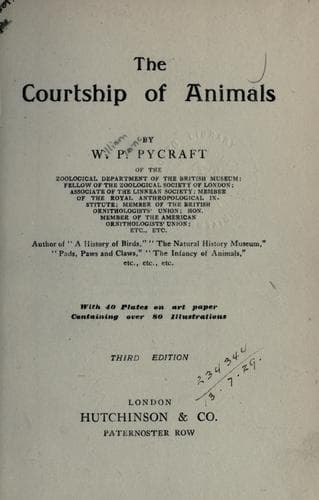
The Courtship of AnimalsPycraft, W. P. (William Plane)
Science
The Courtship of Animals
Pycraft, W. P. (William Plane)
Animal behavior; Natural selection
A survey must now be made of some of the more remarkable cases whereby
more or less musical, or rhythmical, sounds are made by instruments
of percussion; or by rapid vibrations. These are in almost every
instance formed by varying grades of modification in the feathers of
the wings or tail. Their presence, and their use, seem natural enough
until we recall the fact that many other birds without any apparatus
whatever, make sounds in no way less remarkable or less penetrating.
Pigeons, Nightjars and Owls, for example, can produce at will curious
snapping sounds by bringing the wings smartly together over the back.
The White, and Shoebilled Storks make castanets of the beak, throwing
the head backwards till the point of the beak touches the back, when
the jaws are set rapidly clashing one against another, producing a
sound comparable to the “bones” of negro minstrels, but without the
varying rhythm. As this performance is proceeding, the head and neck
are slowly moved through half a circle, till the tip of the beak
touches the ground, when the music ceases. As with the wing-snapping
just referred to, both sexes are equally skilful performers; but while
they seem to indulge in such exercises much more frequently, and with
more vim during the breeding season, they will break out after this
demonstrative fashion at all times of the year. But why, then, the need
for the yet more elaborate contrivances which are to be met with among
the Snipe, the Game-birds, and certain of the Passeres?
However, be this as it may, in a large number of species a special
mechanism has been evolved to produce sounds which, as has been
remarked, in other species are no less effectually made without that
mechanism.
One of the simplest of the cases is that furnished by the remarkable
“bleating” or “drumming” performances of many species of Snipe,
generally, if not only, when sexually excited, and especially of
the Common Snipe (_Gallinago cœlestis_) during its love-flights.
Mounting to a great height, this bird, at such times, suddenly turns,
and descends with prodigious speed, meanwhile holding the tail fully
expanded. The outermost pair of feathers are, however, specially
modified so that, in the first place, during this descent they stand
at right angles to the long axis of the body and well apart from the
rest of the tail-feathers. This alone, however, would not produce these
weird sounds, which owe their origin to the fact that these particular
feathers have their shafts conspicuously thickened and peculiarly
curved, while the vane or web of the inner side of the feather is
of great width and structurally differs from the vanes of the other
feathers, whereby the vane becomes more resistant to the rush of air
caused by the wings during the descent.
Public-domain text, read in full here on John Shaqi.
Reviews
Reviews
No reviews yet
Be the first to share your thoughts on this work.
Elsewhere in the archive
Join the Discussion
Join the discussion
Sign in to leave a comment or review.
Sign InorCreate an account