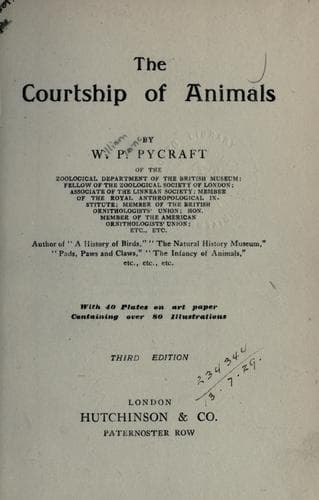
The Courtship of AnimalsPycraft, W. P. (William Plane)
Science
The Courtship of Animals
Pycraft, W. P. (William Plane)
Animal behavior; Natural selection
The part played by musical instruments of percussion would seem to
be a variable one. In some cases, and possibly in all, it may serve
as an excitant, or stimulant, to the rousing of a “sex-storm”; in
many, at any rate, such sounds serve as calls to the sexes when
separated. This much seems to be demonstrated in the case of certain
of the Woodpeckers, which in this matter differ conspicuously from
any other species yet referred to, in that they have developed no
special sound-producing mechanism, but make use of hollow trees which
serve them as drums, the beak being used as the drumstick. This is a
very noteworthy fact, for one would have supposed that here at any
rate, where the production of loud and far-reaching sounds is of
vital importance, the means would have been provided by some such
modification of the wing-feathers as we have already seen to obtain in
the case, for example, of the Manakins. More closely examined, however,
this apparent failure of the organism to produce its own mechanism
becomes less remarkable, for Woodpeckers are forest-dwellers and but
indifferent fliers; loud sounds produced by the rapid vibration of
the wings or tail, as in the case of the Snipe, in mid-air, are thus
impracticable, if not impossible, and sounds produced after the fashion
of the Manakins would not have sufficient carrying power.
One of the most skilled performers among the Woodpeckers is the Great
Spotted Woodpecker (_Dendrocofus major_), whose weird drumming once
heard will never be forgotten. These sounds are produced by blows
of the beak on a branch, delivered so rapidly that the bird’s head
presents but a blurred appearance. The sounds thus made vary with the
resonance of the wood and can be heard at a distance of half a mile.
These strange vibrating notes are most frequently heard during the
courting season, and they will commonly beget a speedy response from
some more or less distant part of the wood, so that their purpose is
clear. They attain the same end as the bellowing of the stag or the
“lek” of the Capercaillie. They are, however, to be heard at other
times, as when the birds are greatly alarmed or when the nest is being
robbed.
CHAPTER VII
THE SEXUAL SELECTION THEORY AS APPLIED TO BIRDS
Where the Rôle of the Sexes is reversed—Polygamy and how it is
brought about—Coloration and Courtship—Instinctive Actions—The
Importance of Landed Possessions—The Meaning of “Display”—The Springs
of “Behaviour”—A New Light on the Wild-duck—The “Display” of the
Great-crested Grebe—Some Neglected Factors.
Public-domain text, read in full here on John Shaqi.
Reviews
Reviews
No reviews yet
Be the first to share your thoughts on this work.
Elsewhere in the archive
Join the Discussion
Join the discussion
Sign in to leave a comment or review.
Sign InorCreate an account