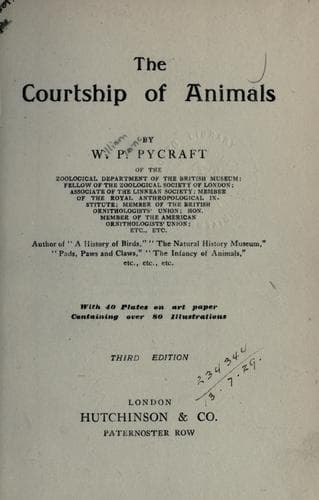
The Courtship of AnimalsPycraft, W. P. (William Plane)
Science
The Courtship of Animals
Pycraft, W. P. (William Plane)
Animal behavior; Natural selection
The same interpretation must obtain where the numerical values of the
sexes is reversed. Failure to appreciate this accounts for one of the
many futile suggestions made for the suppression of the rabbit plague
in Australia, which was that large hauls of these pests should be
made by netting, and that the females should be slain and the males
released. This, it was held, would lead to the speedy reduction of the
latter, which would kill one another in their fights for the remaining
females. The plan was impracticable, but the suggestion demonstrated
the prevalent belief as to the attitude of the male in this respect.
Had it been well founded, surely polyandrous species, whether of birds
or beasts, would never have existed; for, by the reduction of the
males, monogamy would speedily have been restored. How, then, are we to
explain polyandry? How are we to explain the fact, as it seems to be
the fact, that the excess of males has brought about such a complete
reversal in behaviour—the males, instead of the females, requiring
the aphrodisiac? The solution of this problem probably lies with the
physiologist. We now know that the problem of sex does not rest merely
in the complete development of the primary sexual organs; we know that
fertile unions do not depend merely on the act of pairing, but on the
functional activity of those ancillary glands already referred to. And
it may well be that some change in the character of the secretions
has not only altered the numerical values of the sexes, but reversed
the normal rôle of coloration and behaviour. That is to say, neither
polygamy nor polyandry among the lower animals, at any rate, has been
brought about or is maintained by the excessive death-rate due to
combats for possession of mates, but must be explained as demonstrating
inherent changes in the germ-plasm, disturbing the relative proportions
of the sexes and correlated with a profound transformation, not only in
the behaviour of the sexes during the period of reproductive activity,
but also in their physical characteristics.
The action of the primary sexual glands and of the ancillary glands
has, then, to be allowed for in all attempts to interpret behaviour
in sexual matters. No less so must this be the case in regard to the
development of coloration and other forms of ornament, and the genesis
of weapons of offence. But at present we are, in this direction,
dealing with an unknown quantity. The recognition of this, however,
should not deter us from attempting to solve the riddle of sex from the
phenomena which have so far been surveyed.
Public-domain text, read in full here on John Shaqi.
Reviews
Reviews
No reviews yet
Be the first to share your thoughts on this work.
Elsewhere in the archive
Join the Discussion
Join the discussion
Sign in to leave a comment or review.
Sign InorCreate an account