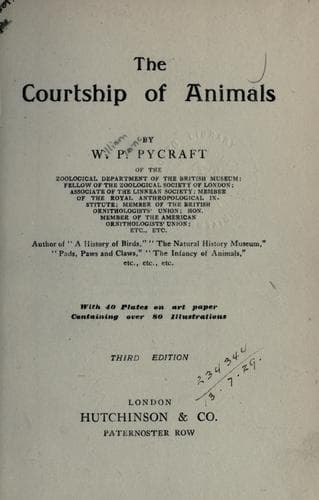
The Courtship of AnimalsPycraft, W. P. (William Plane)
Science
The Courtship of Animals
Pycraft, W. P. (William Plane)
Animal behavior; Natural selection
A study of his work leaves one with the conviction that, while these
birds exhibit what we may call a nascent intelligence, their actions,
on the whole, may be described as instinctive, or congenitally
definite. That is to say, they follow one another in definite
sequence. Hence we must regard each new phase in the chain of events
appertaining to the reproductive cycle, as following one another in
a definite sequence, so that any break therein throws the orderly
performance of the necessary acts out of gear. There is no realization
of what reproduction means, no deliberate striving to achieve that
end. Each new phase brings its own set of associations and sets a new
train of actions in motion, which are performed mechanically. For
instance, these Warblers, like hosts of other species under similar
circumstances, are scrupulously careful to remove the fæces of their
young from the nest; thereby preserving it in a sanitary condition. It
is certain that any neglect to do this would speedily end in the death
of the young. This act is “instinctive”; it is not performed because
the parents have evolved any views on sanitation, and any strain in
whom this instinct was defective would speedily become eliminated.
Mr. Howard has demonstrated the mechanical character of this sanitary
measure by placing leaves in nests of young. The parents, having fed
their offspring, at once seized upon the leaf and commenced to dispose
of it after their usual fashion, first by trying to swallow it and then
by carrying it away. They did not, evidently, realize the difference
between the texture of the leaf and the milk-white, jelly-like envelope
which always encloses the fæcal matter of the nestling. We shall
probably never know how this most vitally important instinct came into
being; nor can we hope to discover what chain of happenings begot the
instinct, which each parent displays, to gently stimulate the cloacal
lips of their offspring in order to induce the discharge of the fæces
when this does not immediately follow the stimulus of swallowing food.
We cannot credit these birds with notions on the importance of the
regular discharge of the evacuations. Equally mysterious is the
development of the envelope enclosing the fæcal matter. This is
jelly-like in substance, and of considerable thickness, and is enclosed
within a very delicate skin or pellicle, enabling one to lift the whole
in the fingers without soiling them. How and where it is formed should
not long evade discovery. But how it has come to be is another matter.
We can, at any rate, vaguely account for responses of the organism to
internal stimuli reacting directly on the individual, but here is an
elaborate mechanism evolved in response to extra-personal needs: and
which cannot be regarded as of exactly the same configuration as the
instinct to feed the young.
Public-domain text, read in full here on John Shaqi.
Reviews
Reviews
No reviews yet
Be the first to share your thoughts on this work.
Elsewhere in the archive
Join the Discussion
Join the discussion
Sign in to leave a comment or review.
Sign InorCreate an account