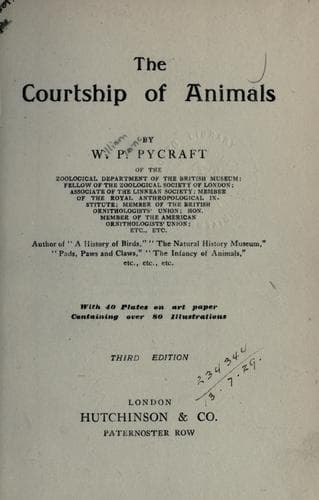
The Courtship of AnimalsPycraft, W. P. (William Plane)
Science
The Courtship of Animals
Pycraft, W. P. (William Plane)
Animal behavior; Natural selection
That the desire for sexual congress is inherently more avid, more
intense, in the male than in the female is often called in question;
and more especially so by those who imagine that they have a mission
to carry on “social reforms” and to regulate the relations between
the sexes of the human race. Such aims and ambitions are commonly
those of the arrogantly ignorant. There are few people who possess a
sufficiently wide knowledge of this theme, or of the factors which
underlie it, to qualify them to become the mentors of their fellow-men
in these matters. However much we may choose to seek refuge in
sophistry, the fact remains that man is still an animal, and if the
human race is to continue he must always remain so.
A lurid light has just been shed on the fierceness of the sexual
passion in the male by Mr. Julian Huxley, who relates some facts
pregnant with meaning to all who have understanding, in regard to what
obtains among birds. These facts are primarily concerned with the
Mallard (_Anas boscas_). This bird is ostensibly monogamous, and, on
the whole, seems to be a fairly considerate mate. The normal period of
pairing having passed, and the duties of incubation having begun, the
female ceases to harbour any further desire for sexual intimacy. Her
whole energies are devoted to nursing her embryonic young into life.
Not so the male. He is yet far from satiated; in him the sexual fever
still burns fiercely, but somehow he seems never to make any attempt to
provoke in his mate a like condition, as in the days before brooding
began. On the other hand, he does not scruple to savagely pursue
every other female who ventures abroad in his neighbourhood. So soon
as a duck takes wing for a brief relaxation from the arduous work of
brooding she is pursued by ten or a dozen already mated males, till
at last she is obliged to descend on the water, and with her descend
her pursuers, now to mob her without mercy. Commonly at least half of
these infuriated males will eventually succeed in treading her; leaving
their victim only after she has become completely exhausted or killed
outright. This is no unusual occurrence. On the reservoirs at Tring,
where every spring from one thousand to one thousand two hundred pairs
congregate to breed, from seven per cent, to ten per cent, of females
are annually killed in this way.
It is just possible, however, that an error may have crept into these
observations. One cannot help asking, may it not be possible that these
pursuing males were actually unmated birds? The chief argument against
this is the fact that there is no sort of attempt to “display” apparent
with these birds, simply an overmastering, ravenous desire to satisfy
the craving which possesses them.
Public-domain text, read in full here on John Shaqi.
Reviews
Reviews
No reviews yet
Be the first to share your thoughts on this work.
Elsewhere in the archive
Join the Discussion
Join the discussion
Sign in to leave a comment or review.
Sign InorCreate an account