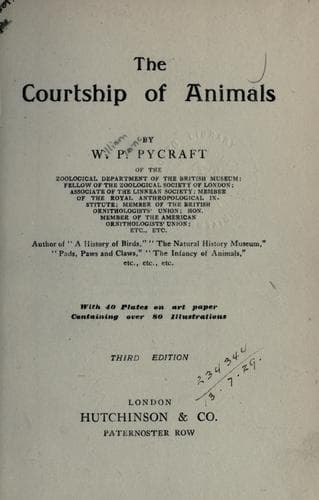
The Courtship of AnimalsPycraft, W. P. (William Plane)
Science
The Courtship of Animals
Pycraft, W. P. (William Plane)
Animal behavior; Natural selection
Normally sluggish, the Lizards display, it will have been remarked, a
quite surprising degree of animation when maddened by mate-hunger. Some
exhibit a considerable degree of pugnacity. In _Anolis carolinensis_,
for example, when two males meet they face one another, bob the head up
and down two or three times, expand the throat pouch, lash their tails
from side to side, and then, worked up to the requisite degree of fury,
rush at one another, rolling over and over and holding firmly with the
teeth. The conflict generally ends in one of the combatants losing his
tail, which is eaten by the victor.
The Chamæleons include among their number species which have developed
quite formidable horns, recalling those of the Rhinoceros or, better,
of the extinct Arsinoetherium, since they are placed side by side
instead of one behind the other. In Owen’s Chamæleon there are three
such horns, two on the forehead and a median horn on the snout, and
these are borne only by the males.
The marvellous play of colour which many Lizards display is commonly
attributed indifferently to “protective coloration” and to “sexual
selection.” It is unlikely that both have played equally important
parts in their development. If the case of certain of the Geckoes alone
is taken, then there would seem to be no doubt but that “Natural
Selection” was the agent which had determined their elaborations
for protective purposes, and in such and similar cases this may be
largely true. But the material which “Natural Selection” has worked
upon has been furnished by the secretions of the sexual glands to
which reference has so frequently been made already. These seem to
possess a very marked tendency to contain an excitant which promotes
the formation of intense pigmentation, or an excess of tissue which
may assume the form of weapons of offence, or of excrescences in the
form of spines, or other ornamental features. Animals in whom this
tendency to pigmentation and ornament has developed must, so to speak,
obtain a licence from “Natural Selection” if they are to retain it.
That is to say, if such ornament whenever it appears makes the wearer
conspicuous to its enemies, or hampers it in escaping therefrom, or in
fulfilling the ordinary avocations of life, then its further progress
will be inhibited, or the wearer will be exterminated. But the tendency
to produce colour, a by-product of the sexual gland secretions, may
incidentally serve to afford it a protective garb, and in this event
its further elaboration in the required direction is assured.
Public-domain text, read in full here on John Shaqi.
Reviews
Reviews
No reviews yet
Be the first to share your thoughts on this work.
Elsewhere in the archive
Join the Discussion
Join the discussion
Sign in to leave a comment or review.
Sign InorCreate an account